Poem For The End of The World
I tear up
but that is not true
I pull the shirt over my head as always
and
put my pants on
both legs at the same time
Outside it is 10 degrees there is a car idling
Severe clear sky
but I have told you nothing
of the pack of coyotes that stared in my window
we made eye contact they were large amber pools
they were hungry and cold and that glass
was so thin
I tear up
and it is because of the cold
I send the scraper over the windshield
and
gloved hands to the wheel
10 and 2
I turn the wheel
and it makes the sound of nails of board
21 December 2012


19 December 2012
Bewilderment
First off, over here, Eric Forbes gives us a list of books to look forward to in 2013.
Last year I did a run down of what I read, how I liked it, etc. This year I don't have a list for you. Sorry, I didn't keep track. And I moved.
But! I have started to write posts about books I have been reading. I will continue that as long as I can discuss them in some broader context and by the end of 2013 we'll have a list of things I read without even trying!
 Upon moving back to Santa Fe I have reconnected with old friends and places. I have been going to poetry readings and art openings. I have been at cocktail parties and, in general, been a real boy. A friend of mine had recently read David Ferry's Bewilderment. She recommended it, with a caveat:
Take it as a whole work.
The book is in sections. Each has a clear tone and arc to it. Each is a mix of poems and translations. The translations range from Virgil to Rilke to Cavafy to Horace. The connecting theme is one of time, and old age.
Ferry is 88. It is not my place to say that he is thinking about endings. But.
Aunt Nellie's picture was in the paper once,
Triumphantly posing with a large bottle,
Black widow spiders inside looking out,
As conscious as fireflies of their situation.
 Are we conscious of our situation? That is the question I took away from Ferry's book. I write about decay in my own poetry. I have been obsessed with the idea of entropy for years. But am I conscious of being in the jar?
So the 'jar' is life itself. The fact that we are born and begin to fall apart immediately. Cell walls start to break down, chemicals begin their depletion, etc. etc. etc.
That word, etc., is a good example of the jar. It is such a small word, a placeholder really. But it contains multitudes of the unspeakable.
If we follow that train of thought a bit, we arrive at all language being mere placeholders for the things we are really trying to say. 'Apples' is not the actual fruit. Shine or no shine. Red or green. All of it, placeholders.
And Ferry seems to be pointing out that his words are merely newer versions of the old. The translations bleeding into his poems and his poems informing the depth of the old. And they all speak with the same voice across time. We are merely the same. Placeholding away.
Last year I did a run down of what I read, how I liked it, etc. This year I don't have a list for you. Sorry, I didn't keep track. And I moved.
But! I have started to write posts about books I have been reading. I will continue that as long as I can discuss them in some broader context and by the end of 2013 we'll have a list of things I read without even trying!
 Upon moving back to Santa Fe I have reconnected with old friends and places. I have been going to poetry readings and art openings. I have been at cocktail parties and, in general, been a real boy. A friend of mine had recently read David Ferry's Bewilderment. She recommended it, with a caveat:
Take it as a whole work.
The book is in sections. Each has a clear tone and arc to it. Each is a mix of poems and translations. The translations range from Virgil to Rilke to Cavafy to Horace. The connecting theme is one of time, and old age.
Ferry is 88. It is not my place to say that he is thinking about endings. But.
Aunt Nellie's picture was in the paper once,
Triumphantly posing with a large bottle,
Black widow spiders inside looking out,
As conscious as fireflies of their situation.
 Are we conscious of our situation? That is the question I took away from Ferry's book. I write about decay in my own poetry. I have been obsessed with the idea of entropy for years. But am I conscious of being in the jar?
So the 'jar' is life itself. The fact that we are born and begin to fall apart immediately. Cell walls start to break down, chemicals begin their depletion, etc. etc. etc.
That word, etc., is a good example of the jar. It is such a small word, a placeholder really. But it contains multitudes of the unspeakable.
If we follow that train of thought a bit, we arrive at all language being mere placeholders for the things we are really trying to say. 'Apples' is not the actual fruit. Shine or no shine. Red or green. All of it, placeholders.
And Ferry seems to be pointing out that his words are merely newer versions of the old. The translations bleeding into his poems and his poems informing the depth of the old. And they all speak with the same voice across time. We are merely the same. Placeholding away.
17 December 2012
Dust Jacket : In Cold Blood

Designed by: Megan Wilson
Photo: William Eggleston
Megan Wilson is an associate art director at Vintage/Random House. She's been there for 20 years. She runs a blog and store called Ancient Industries that aesthetically connects to her beautiful covers.
There is a sense of the 1950s. Enameled pots and crisp aprons. Small flowers in vases. White gloves.

It is a beautified vision. A Mad Men Audrey Hepburn universe. A place that was somehow more. Before the Vietnam War, the peace/love movement. Before things went 'bad'.
It never existed, but it is nice to think it did.
In Cold Blood is about the brutal 1959 murders of the Clutter family. It is, more than anything, about the loss of the ideal of family. The end to that make-believe world of the 1950s.
The cover presents an American pastoral. The photo is by William Eggleston. Eudora Welty said of his work:
"The extraordinary, compelling, honest, beautiful and unsparing photographs all have to do with the quality of our lives in the ongoing world: they succeed in showing us the grain of the present, like the cross-section of a tree.... They focus on the mundane world. But no subject is fuller of implications than the mundane world!"

The cloud over the landscape. The storm on the horizon. Though not a storm. Something else. The photo, and Capote's book seem to say that this is a new normal. A fact we must face.
And what of that? Is it true?
On December 14th America was shocked by the senseless murder of 20 children and 6 adults in Newtown, Connecticut. It is the latest in a long history of senseless killings.
From the Brady Campaign: In one year, guns murdered 17 people in Finland, 35 in Australia, 39 in England and Wales, 60 in Spain, 194 in Germany, 200 in Canada, and 9,484 in the United States.
I don't have an 'answer' or a 'suggestion' on this. I don't know that Capote saw or had thoughts on the state of American crime. I don't believe Eggleston knew he was capturing a vanishing world. The world he captured was imagined in his lens. Capote's on the page.
We are left with enameled pots and pans. A hand on a stir stick. A cloud on the horizon. Ephemeral and beautiful and terrible.

Dust Jacket is a sometime article about the design and art of book covers. The idea is to shine a spotlight on the work of the designer separate from the author. Literally judging a book by its cover.
12 December 2012
Phantom Time

It did that outside this weekend! Which meant I couldn't really walk the streets looking for work. If you know what I mean.
Being unemployed is weird. You'd think I would spend my time writing up a storm. Instead I have watched a ton of Star Trek and Top Gear and read.
 |
| Geordi misses me if I don't check in. |
But the time has just vanished. It doesn't help that we are moving into winter, with its long dark nights and late sunrises.
And it doesn't help that I am car less. In a new place. With limited resources.
The idea that time passes differently depending on your state of mind, etc. is not a new one. And not something I need to explain. It is observable.
In 1991 a man named Heribert Illig devised a theory involving missing time. More accurately, phantom time.
Illig proposed that the years 614-911 did not exist.
Literally.
He says that there is lack of archaeological evidence from those years. That Romanesque architecture in western Europe means that less than half a millennium could have passed due to weathering, etc. He also says that Charlemagne did not exist and was a construct of Otto III, who wanted so desperately to rule in the year 1000 that he had his scribes add 297 years to the calendar.
So it's 1715 and we are a long way off from the Mayan Apocalypse. And I can feel better about my lounging around. Or something.
What's strange is that I can see a ruler asking his court to invent time for him. I can see it working too. All you'd have to do is rule long enough and get others to follow suit. European politics is a fucked up land of nonsense and inter-familial marriages. They would totally conspire to make them all be rulers in the year 1000.
I mean Otto was king of Germany, Italy and the Holy Roman Empire, so it's not so far fetched.
Illig's theory isn't even the only one. Anatoly Fomenko has an entire rewritten world history to his credit. His 'New Chronology' has written history starting at 800AD and 'folds' all ancient history into the Middle Ages.
You can even buy the 7-volume re-history yourself. $10 a piece on Amazon!

All of this is to say. I'm clearly wasting time and not getting anything of value done. No working on novel. No poetry. No job.
And I am fine with it. I'll just edit those bits out later.
10 December 2012
Mayapocalypoetry

Every year, in early January, I make a new folder on my desktop for that year's writing. Then at the end of the year I move the folder into the broader 'writing' folder on my external hard drive. Thus I complete my organizational rituals over my writing.
I don't print my writing out. Keep it in a filing cabinet or any of that. This is more out of cost than any real strong feeling on the issue. And space. I'd need another room for all that paper.
This year I am on track to only having 12 new things to show for my year. One a month. This is the smallest amount of work I have ever produced. Ever.
I can blame the novel. The move. The relationship. Whatever. It is not the truth though. The truth is that I have less to say in 2012. Or less I am interested in putting down.
I was discussing with J the other day about a decision I have to make. There is a certain type of poem I write that seems to get published. You can check out the latest Spittoon for an example of what I'm talking about.
That poem, is about a relationship. Or about language failing in a relationship. Or about how you are never as close as you want to be. Never exactly the same while being EXACTLY the same.
So what is the decision?
Publications seem to be into my 'relationship' poems. Ones with clear 'I' and 'You' and maybe some hand holding and some walking and a dose of existential ennui. And I am clearly able to write those things. But -
 |
| Who WILL save your soul? |
The decision is to either put my energy in that basket and do it whole hog or, to continue as I have.
I'm not saying to turn my back on writing that fulfills me. Just to attempt to focus on writing that seems to be connecting with people more. Should I write a whole swath of 'relationship' poems? Trying to fill them with whatever I can to make them interesting, in the hopes that they find an audience?
I like to joke that the writer who wins is the one who keeps at it longest. After everyone else has fallen to the side they have no choice but to hand you the Nobel.
I have no solution. J thinks I can do both. With only 12 poems this year, I am clearly in need of making a commitment to A thing. But is it even a choice?
In the meantime, I have been re-working the novel and writing poems about taking my skeleton on walks. I count them as 2013 poems.
07 December 2012
Lose Your Mother
Poetry readings and I don't always get along. I find them tiring. I communicate better with words on page than in the air around me. Listening for more than 20 minutes and I get a bit ADHD and start to examine the walls of the room I'm in for peeling paint.
I have a similar problem with music. I don't really absorb lyrics while listening. Not in a 'I understand the thesis of the song' kind of way. More in a 'words are happening' kind of way.
Tonight, J and I went to a great poetry reading at Collected Works in downtown Santa Fe. Muse Time Two is a series that pairs a local NM poet with a wider-known more established writer. The pairings often illuminate each authors work. I like the idea.
Tonight's reading was by Connie Voisine and Martha Collins. Voisine is the director of the writing program at NMSU in Las Cruces. Her poetry was beautiful.
Collins read from her books Blue Front (2006) and White Papers (2012). They are companion books about race, specifically race from a white American point of view.
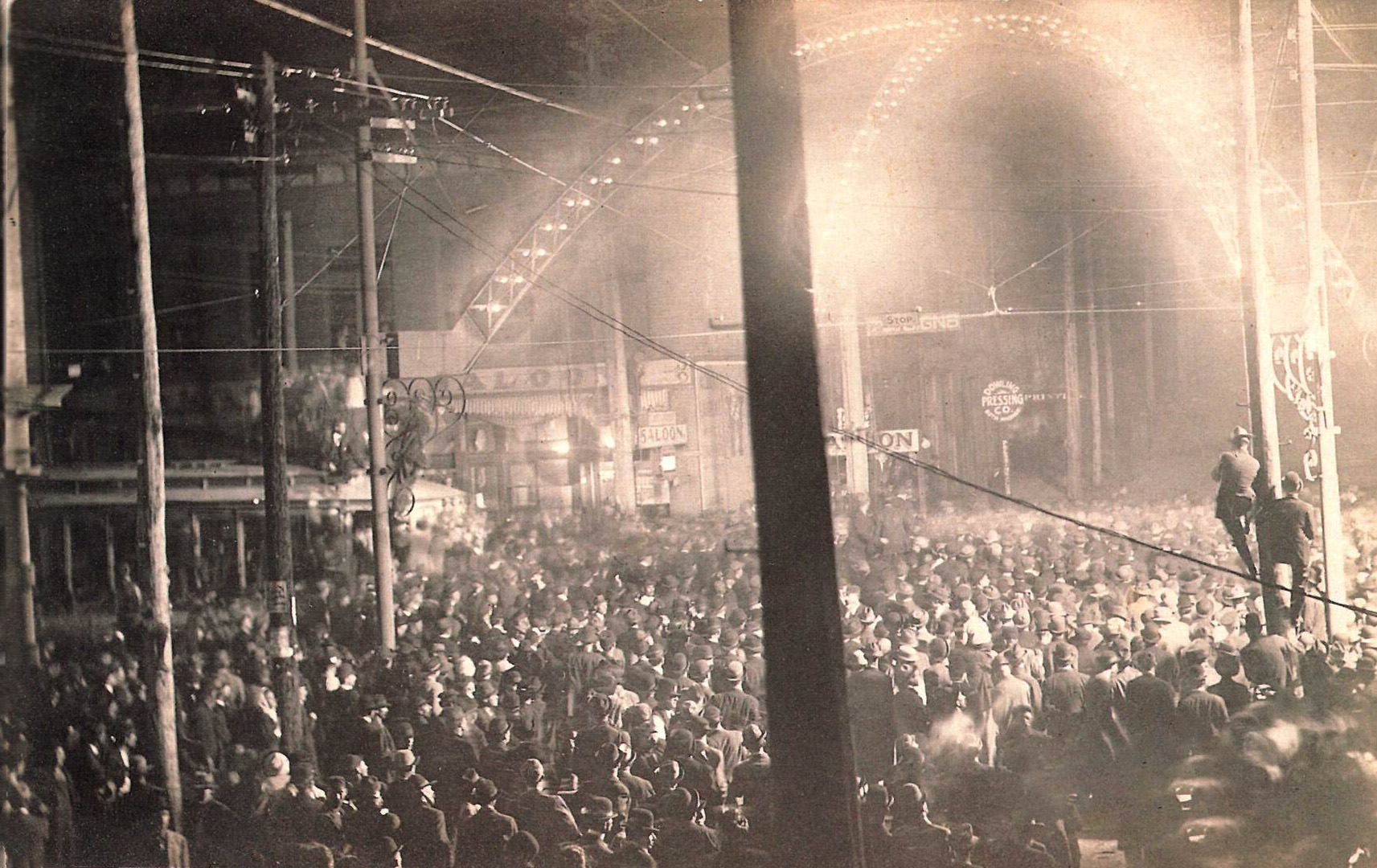
Blue Front seems to be the stronger of the two books. It is centered around Collins' father witnessing the hanging in 1909 of Will James. There were 10,000 participants.
I want to let that number linger for a second. 10,000 people helped hang someone in 1909 in Cairo, Illinois in front of a restaurant named the Blue Front. In front of a 5 year-old boy. Below is a photo of the event.
The poems Collins read were a little too disjointed, a little too knowing. There was an aura of self-consciousness. Too aware of the topic. Obviously you are aware of it, but it was all a touch too blunt. Too 'white liberal guilt'. The moments of brilliance came in the unanswered and cut off questions. She had an entire poem with each line starting 'Because...' and not a one had an ending.
My stumbling into Collins poetry is an interesting coincidence. I just read Lose Your Mother by Saidiya Hartman. A similar examination of race but from the other side.
Hartman examines the African slave trade by taking a trip to Ghana. She attempts to connect with a place that is meant to be 'home'. She finds ambivalence and, in some cases, outright anger at her presence. At her insistence of bringing up the horrors of selling people.
Ghana's politics on slavery are not easy water to tread. There is a modern slave trade that continues to this day. The view is that you are selling strangers, criminals, the non-religious and is therefor not a problem. Hartman paints several scenes of people telling her that the trade was bad when white men did it. They caused the problem. Her attempts to get locals to address the nobles of Africa selling off their own is met with silence.
Both of these books attempt to address race in a new way. From a different entry point. Collins comes at it with poetry and by addressing her whiteness. And using that as a means to open up what her being that means in America. She addresses blackness by acknowledging she can only address whiteness.
Hartman attempts to come at the topic of slavery honestly. She wants to see how the African tribes were complicit in the trade. She admits that going to Ghana, standing in the old Elmina castle does nothing to fill the empty space she feels. As a white man reading her book, I felt like that is the problem of the slave trade. There is no way to fill that space.
Both of these women address race calmly, without anger or melodrama. They also do it by telling their own stories. Collins tells that of her father and that 10,000 strong lynch mob. Hartman writes herself into the narrative, allowing us to see her disappointment and struggle with the topic.
Hartman manages a delicate balance of listing those accountable while not pointing a finger at the reader. Collins is less successful, but she has less room to do so. It is not her topic to be gracious about. It is not a topic to be gracious about. It is to Hartman's credit that she has chosen to open the topic up in this way.
I am grateful for Hartman's abilities to let me, a white man, into the conversation. I feel like it comes across condescending to say, but it is true. Being honest about our feelings on race is the first step to even begin to pretend to fix the problem.
 |
| First image from a search - 'poetry reading' |
Tonight, J and I went to a great poetry reading at Collected Works in downtown Santa Fe. Muse Time Two is a series that pairs a local NM poet with a wider-known more established writer. The pairings often illuminate each authors work. I like the idea.
Tonight's reading was by Connie Voisine and Martha Collins. Voisine is the director of the writing program at NMSU in Las Cruces. Her poetry was beautiful.
Collins read from her books Blue Front (2006) and White Papers (2012). They are companion books about race, specifically race from a white American point of view.
Blue Front seems to be the stronger of the two books. It is centered around Collins' father witnessing the hanging in 1909 of Will James. There were 10,000 participants.
I want to let that number linger for a second. 10,000 people helped hang someone in 1909 in Cairo, Illinois in front of a restaurant named the Blue Front. In front of a 5 year-old boy. Below is a photo of the event.
The poems Collins read were a little too disjointed, a little too knowing. There was an aura of self-consciousness. Too aware of the topic. Obviously you are aware of it, but it was all a touch too blunt. Too 'white liberal guilt'. The moments of brilliance came in the unanswered and cut off questions. She had an entire poem with each line starting 'Because...' and not a one had an ending.
My stumbling into Collins poetry is an interesting coincidence. I just read Lose Your Mother by Saidiya Hartman. A similar examination of race but from the other side.
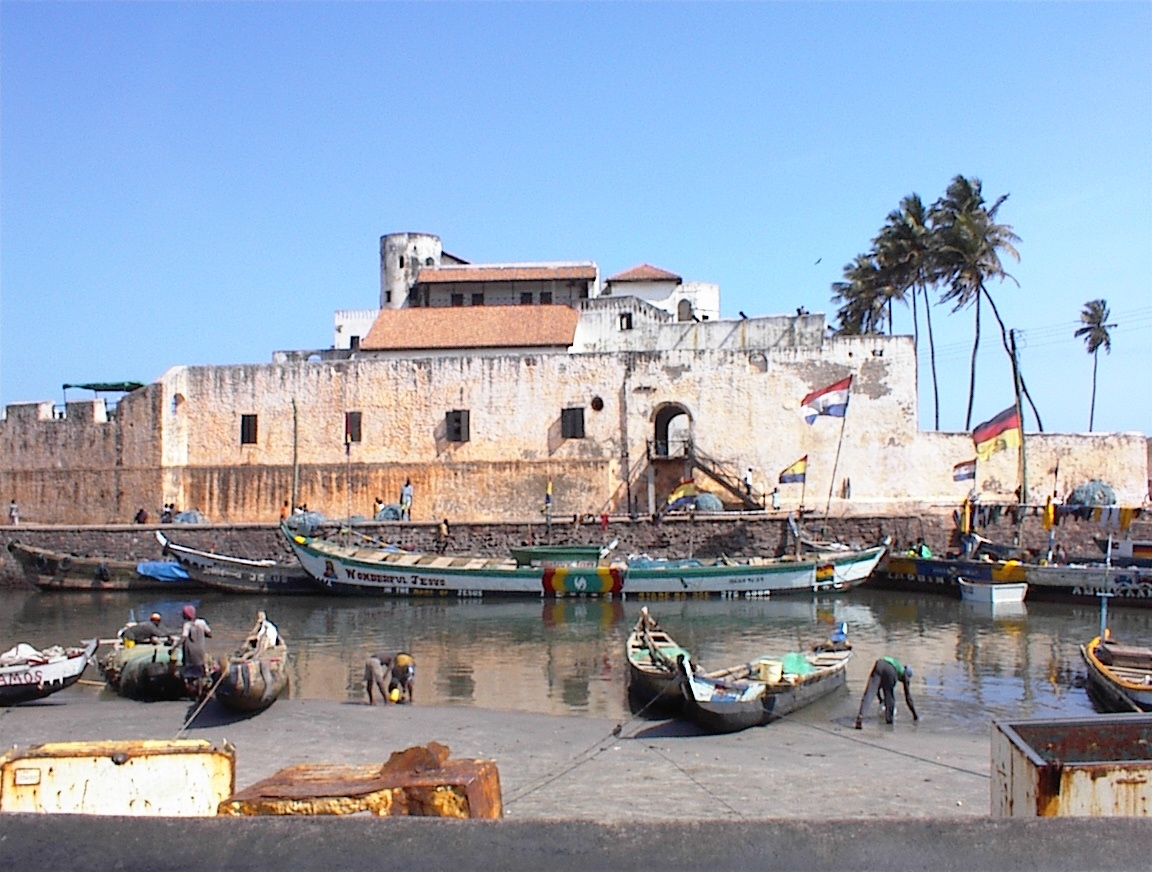
Hartman examines the African slave trade by taking a trip to Ghana. She attempts to connect with a place that is meant to be 'home'. She finds ambivalence and, in some cases, outright anger at her presence. At her insistence of bringing up the horrors of selling people.
 |
| Elmina Castle - Portuguese slave trading post |
Both of these books attempt to address race in a new way. From a different entry point. Collins comes at it with poetry and by addressing her whiteness. And using that as a means to open up what her being that means in America. She addresses blackness by acknowledging she can only address whiteness.
Hartman attempts to come at the topic of slavery honestly. She wants to see how the African tribes were complicit in the trade. She admits that going to Ghana, standing in the old Elmina castle does nothing to fill the empty space she feels. As a white man reading her book, I felt like that is the problem of the slave trade. There is no way to fill that space.
Both of these women address race calmly, without anger or melodrama. They also do it by telling their own stories. Collins tells that of her father and that 10,000 strong lynch mob. Hartman writes herself into the narrative, allowing us to see her disappointment and struggle with the topic.
Hartman manages a delicate balance of listing those accountable while not pointing a finger at the reader. Collins is less successful, but she has less room to do so. It is not her topic to be gracious about. It is not a topic to be gracious about. It is to Hartman's credit that she has chosen to open the topic up in this way.
I am grateful for Hartman's abilities to let me, a white man, into the conversation. I feel like it comes across condescending to say, but it is true. Being honest about our feelings on race is the first step to even begin to pretend to fix the problem.
03 December 2012
The Book of Nightmares

a small fire goes on flaring in the rain, in the desolate ashes.
No matter now, whom it was built for,
it keeps its flames,
it warms
everyone who might wander into its radiance,
a tree, a lost animal, the stones,
because in the dying world it was set burning.
This is how the final section of Galway Kinnell's Book of Nightmares begins. What comes before and after is a harrowing and deeply dark journey through a strange wood. He recounts his daughter's birth, he dedicates it to her after he is gone and she is orphaned. The book in whole is dedicated to both of his children.
To call the book-length poem 'dark' is honestly to generalize what is going on. Nightmares was written in 1971 when Kinnell was 44. It starts with references to his young daughter and then veers into the Vietnam war and the civil rights movement. There are bears and fires and old crones drawing runes. The whole is buried in a Medieval feel. A sense of hearths and mud houses. Of black death and superstition.
He is equating our world with theirs.
It was this strange alchemy that drew me in from the first few words.
When I was 19 we had just come out of the Clinton years. It was a national high. I'm not even referring to the politics of the era, I was honestly an unengaged teenager and the time I lived in allowed that. The Clinton years were good for the country. We were seemingly prosperous, had come out of the 'culture wars' with new found tolerance (HA!) and were about to elect Al Gore President.
The 2000 election was not that election though.
The cynicism of a teenager mixed with the deep cynicism of the early 2000s is hard to explain. I think the US was in a fog post-election. Unwilling to really look at what had happened and deeply distrustful of the entire 'experiment' of American democracy.
The world seemed dark. Seemed like the world of the 1970s. Or, at least, what a 19 year-old thought the 70s were like.
The first section of the poem ends with:
And in the days
when you find yourself orphaned,
emptied
of all wind-singing, of light,
the pieces of cursed bread on your tongue,
may there come back to you
a voice,
spectral, calling you
sister!
from everything that dies.
And then
you shall open
this book, even if it is the book of nightmares.
I read those lines, and still do today, as an address to me. Telling me that even in the darkness there is a small fire, a voice. My own voice. The voice of others. And that will be what saves us.
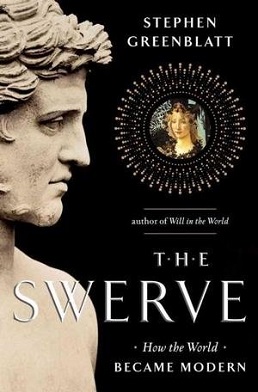
The Swerve details Poggio Bracciolini's discovery in 1417 and the resulting spread of the text.
Greenblatt argues that Lucretius' poem sowed the seeds of the Rennaissance, and thus all of modern thought.
I don't know if I agree with him. But the poem spread like wildfire and espoused a decidedly secular view of the world. It even went so far as to deny god in creating the universe, to deny fate. It names atoms. It talked up the beauty in living for pleasure not pain.
It was not a 1417 kind of work and was banned, burned and tried to be put back in its box numerous times.
Ideas are hard to kill. The voice in the dark is a thread that leads to whatever warmth may be needed.
Kinnell meant his poem to be a modern take on T.S. Elliot's Wasteland. An attempt, however futile, to reconnect the world in a moment of upheaval. The Vietnam War and the civil rights struggle were tearing the country apart. The promises that after World War II things would be 'normal' again, would be 'better' had proven false. He retreated to the woods, to nature, to the occult. He tried to bleed himself of it.
In 2000 these words seemed like prophecy. Today, they seem even more prescient. They call from the past and want something from us. We are tasked with building a fire, with calling to those lost in the woods. With building a shelter and dredging the past.
In 2000 that kept me moving. Kept me wanting to do this whole 'writing' thing. Today, even more so.
Subscribe to:
Posts (Atom)