29 March 2013

Graft

'Basket Tree' by Axel Erlandson.
Created by grafting 6 sycamore trees.
The apricot tree in my backyard is blooming. It was covered in little white flowers this morning and the honey bees were making enough of a racket that I thought they were a generator.

The apricot was cultivated in ancient times, pits of apricot trees have been found in sites dating from the copper age - 7000 years ago - in Greece. It is thought the trees were cultivated much earlier. Due to this, the place of origin is unknown. The Latin name - Prunus armeniaca - which translates as 'Armenian plum' comes from a common belief that the plant is from that part of Eurasia.

Apricots are related to peaches, cherries, and almonds. Amaretto is traditionally made from the apricot seed, not almonds, since they are sweeter. Just like almonds, the seeds of the apricots contain cyanide. But only about 2.5% and so they are not dangerous.

Fruit cultivation is such a strange process. The grafting of trees to hybridize or continue strong root system is fascinating.

That this is how many trees were cultivated thousands of years ago is even more interesting. The idea that you could take two parts of two different trees, stick them together, and they would continue - even thrive - is a leap of thought that we are not necessarily trained to make. One that few of us could come up with today.

That leap is what leads to progress. Culturally or otherwise. It also informs how one gets from point A to point Z in a poem or a work of art. You must go with the words on the page, choose to follow through, hope they arrive intact at the destination.

For more tree stuff you can check out an interview I did over at Poets Touching Trees.

27 March 2013

Rust

Gardening is a process.

One that can fail easily. If you forget to water for a few days. If you plant a week too soon - nothing will happen

I'm about to get all kinds of cliched - so clench your jaw - Writing is the same sort of process.

Sometimes it's not right. It's too cold, or dry, or the wrong zone for the seed.

JG and I had a back and forth on Facebook about this very thing on Monday. She is having a hard time with it right now. Rejection letters, a general lack of desire, a consuming real life. These are things that do not lead to healthy plant life.

Let's put it this way:

There was a rainy year in South America and it has led to more than 30% of coffee crops being hit with a fungal infection called 'coffee rust'.

The blight has led to a huge loss in the industry. A possible shortage. Talk of changing generations of precedent for new hybrid coffee plants. Or even to a different crop altogether. To kill the fungus farmers are burning their fields.

In the 18th and 19th century the UK controlled huge coffee plantations in India and Ceylon (now Sri Lanka). You don't drink India or Ceylon varietals at your local cafe because coffee rust claimed enough of those plantations by the mid-19th century to lead to a switch in production. To tea.

And while I didn't use these words with JG, I basically suggested the same thing. Switch production. Re-plow or something.
Take a damn break.

And be OK with that.

Because you should be doing this because you want to. You should be doing the thing you want to, the way you want to. And that means experimenting with what to put where.

How often to water. What time of year is best. Putting out some compost.

And knowing when it's time to let the field go fallow for a season.

25 March 2013

My Baby Has Two Twitter Accounts A Facebook And A Tumblr

Recently I got into a minor Facebook scuffle over my honest discomfort with people sharing their children's photos on the social network.

My issue is not that people want to share their children, their love, etc. with people that should get to see these pictures.

My issue is that I also get to see these pictures. That these pictures are on Facebook, Instagram, whatever, servers. Most likely for a long time (forever). My issue is that putting these photos on these sites allows your life, your property, your children to have parts of themselves controlled by large corporations.

What happens when Instagram shuts off its servers? What if Facebook decides to utilize the weird parts of its user policy that states they own your content? What happens when that baby is a teenager, an adult looking for work, or a parent themselves ans these photos are still floating around?

People got upset with me and told me to just ignore the posts. To 'silence' them on my feed. But that wasn't the point of my post. I was genuinely asking why we decide to place ourselves and then our children out there like this.

Some said that the privacy setting means only friends can see the photos. But why do I get to see baby photos of people I don't know? Is it because they didn't understand the privacy settings? Is it because they aren't really private? I'm not a creeper, but there certainly are people out there who are. If I can see the photo without wanting to, I'm sure others can too.

Some said it was easier than e-mail. Which...just...no. It isn't. Yes, you can post 100 photos of your week old on Facebook and tell everyone to go look. But we don't need 100 photos. Put a few good ones in an e-mail and hit send to the handful that should see them. When we had cameras and film, we didn't send 100 photos to grandma. We sent the best we could take.

I am in no way an anti internet presence type person. I have Twitter, Facebook, I blog regularly, and I write online reviews. I am firmly online.

I believe we all should get to make that choice though. And I also think we should be protecting our children better. Why do we allow babies to have internet footprints but don't allow children to trick-or-treat in neighborhoods any more? I understand that the two have little to do with each other but I bet the answer is that trick-or-treating is 'not safe'.

Yet internet footprints are...

I'm genuinely not sold on the arguments on the pro side of this.

I know this has zero to do with writing, publishing, or anything like that. But it's been bothering me lately. So there it is.

21 March 2013

Sorry I am MIA. I am working on a long for of an old post/thought/thing and need time. I will be back tomorrow with ... something?

18 March 2013

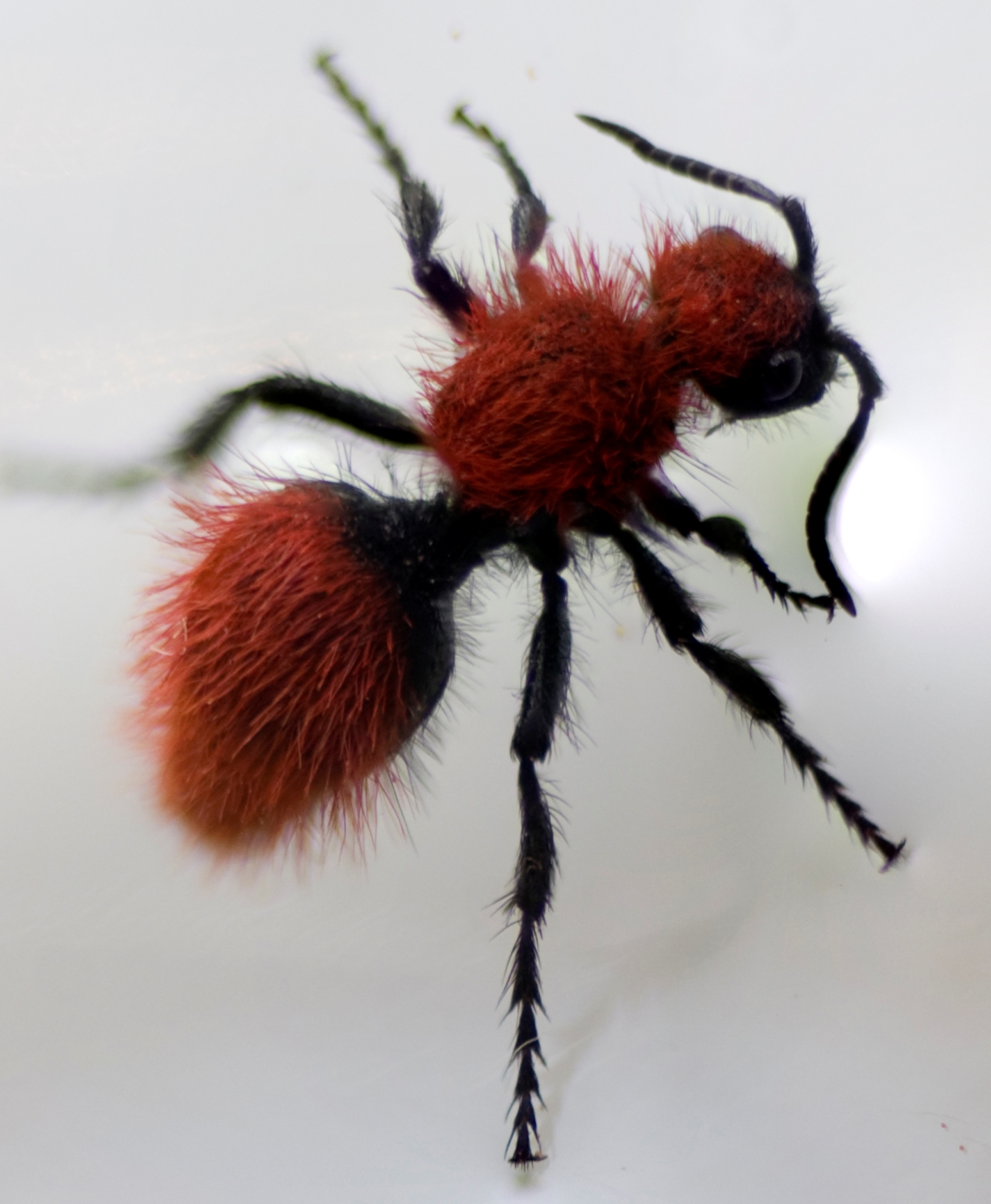
Velvet Ant


That is a velvet ant.

It isn't really an ant at all.

It is a wingless wasp in the family Mutillidae. There are over 3000 species in this family whose female members all resemble large, hairy ants. They live in dry desert climates.

There are 400 species of these things in the southwestern US.

Their hair can be red, orange, silver, white, black, or gold.

They are also called cow killer ants because they have incredible painful stings and are known to attack cows and other livestock.

Unlike real ants, velvet ants are solitary. They do not have drones, workers, or queens.

They do have incredibly hard exoskeletons that are known for breaking the steel pins used by entomologists.

Eggs are laid inside other insect nests, near the young of the home insect. When they hatch, the velvet ant young kill and eat the larva of the home insect.

The female has a long movable stinger.

Velvet ants are known to squeal when stepped on or crushed.

The more you know...

13 March 2013

SALIGIA

Hieronymus Bosch - The Seven Deadly Sins and the Four Last Things
I know people who have a hard time with friends being published. I have been in a situation where upon telling someone of a recent publication they talk about their own work in the context of how they really should get it out there more. This communicates that 'if you could do it, so could I'. And I feel it, I really do. But that reaction is not supportive.

People I know getting their work out there is a win-win. It allows me to say that they are good people and deserve it. Do I feel that little pang of 'why not me?' Of course. But I know that the people getting published are worth it.

It also allows for the mighty connection. And those are bread and butter honey. Envy really starts to rear its head when we start talking about books. There I can be catty, downright mean. Mostly I become self-loathing and terribly lazy with my own work.

I'm not even positive of why I have an internal distinction. It could be that a 'book' is a physical manifestation of timelessness. It means libraries, classrooms, generations, translations. It means being on shelves. Being in a magazine more and more means being at the end of a link - blahblahblah.com/yournamehere

The seven deadly sins are, of course, Wrath, Greed, Sloth, Pride, Lust, Envy, and Gluttony. These sins do not really pop up in the bible though. There are two places where the book gets specific with what pisses off the lord. In Proverbs 6:16-19 the list is given as:

1. A proud look.
2. A lying tongue.
3. Hands that shed innocent blood.
4. A heart that devises wicked plots.
5. Feet that are swift to run into mischief.
6. A deceitful witness that uttereth lies.
7. Him that soweth discord among brethren.


In Galatians 5:19-21 it is:

adultery, fornication, uncleanness, lasciviousness, idolatry, sorcery, hatred, variance, emulations, wrath, strife, seditions, heresies, envyings, murders, drunkenness, revellings, 'and such like'

The current sins don't enter the world until the 4th century, though in slightly different variations. They took their current form when Pope Gregory I standardized the list in AD 590.

I am partial to the original Latin sins. There were 8 of those: Gula (gluttony), Fornicatio (lust), Avaritia (greed), Superbia (pride), Tristitia (sorrow/despair/despondency), Ira (wrath), Vanagloria (vainglory), and Acedia (sloth).

I look at the list and kinda love the lost sins.
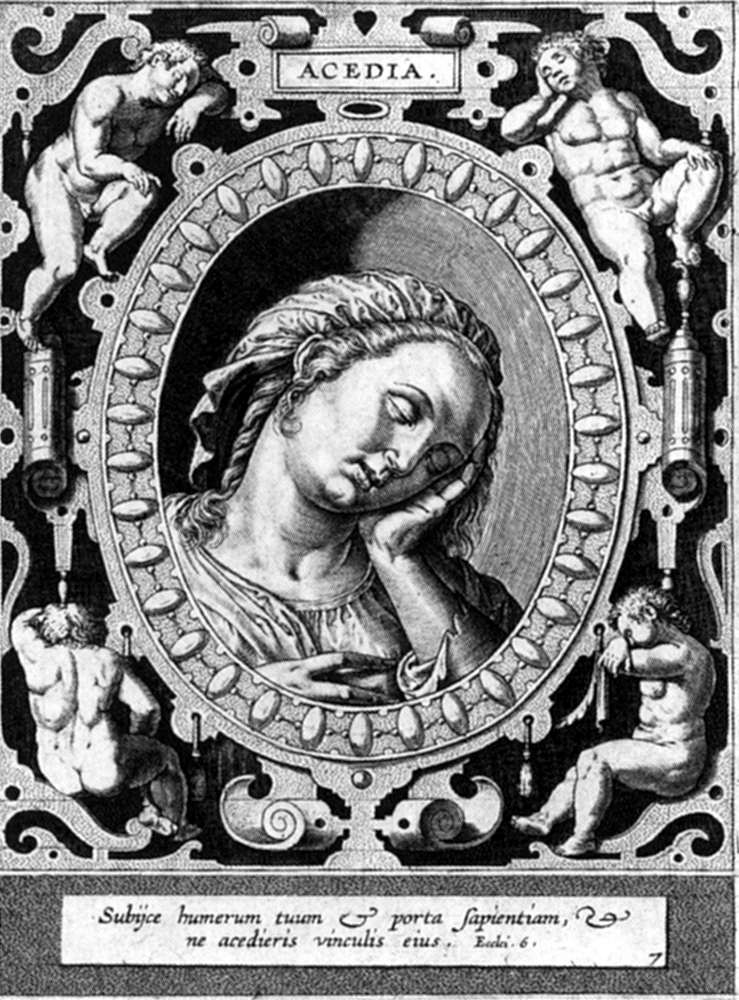
Hieronymus Wierix
Acedia is apathetic listlessness or depression without joy. This was changed into Sloth over time. I figure it is because it is not as directly translatable. It is similar to ennui. Or the feeling I get when someone I know publishes a book.

Vainglory is unjustified boasting. The semantic change of the word vain from 'futile' to 'narcissism' led to this being folded into the larger Pride. Again, slightly ill defined. Also very far-reaching. Point me to someone who hasn't boasted once or twice.

Gregory I also got rid of Tristitia, adding Envy in its place. The idea that despair is a sin. A 'going to hell' sin...is amazing. It speaks to the harshness of the early church.

These three are evocative to me, more so than the others. I can point to places where I feel them when I read the work of friends. When I smile and say congratulations. I see it in myself when I don't submit to a magazine because I feel like the whole thing is rigged and stupid. I see it when I stare at the words I've written and want to delete until it's blank again. I see it when I talk myself up. When I say things like 'Your poetry is ho shit' and 'My poetry will read yours to filth'.

I see it, for what it is, smoke and mirrors. I love that people I know. People whom I critiqued in workshop, have become something. And I continue, with the idea that I am something too. Perhaps the 'sins' are there to light that fire. To keep us striving towards something more like the 7 graces - humility, charity, kindness, patience, chastity, temperance, and diligence.

Emphasis on the diligence.

11 March 2013

Don't Want No Short...

This has been called the best book of 2013
Short fiction is having a bit of a moment. 2013 has seen the high profile publications of George Saunders' Tenth of December and Karen Russell's Vampires in the Lemon Grove. I've read two collections of stories for Publisher's Weekly in the last few weeks. One good and one OK.

In general I am not a huge short story fan. I find most to be lacking in actual story. A lot of writers devolve into telling only parts of a story. And the recent development of stories without endings only amplifies itself in the world of short fiction.

There are a few short works I really do love. Ursula K. Le Guin's The Ones Who Walk Away from Omelas is an obvious one. It is a beautifully told allegory of what it takes to live in society. It is harsh and deeply resonant the first time you read it and reach the point of the 'reveal' of the child shackled in the basement.

Jorge Luis Borges' The Garden of Forking Paths manages to make writing and books themselves events. They become trap and home.  They are concept and enacting of concept. Similarly, Julio Cortazar's A Continuity of Parks manages the feat of making a reader turn in their chair at the last sentence to make sure they are not being watched.

Jorge Luis Borges
There are, of course, Conrad's Heart of Darkness and nearly anything Flannery O'Connor produced is perfect.

One of the best images is in Charlotte Perkins Gilman's The Yellow Wallpaper. That of a person entering an image. And of course the subtle violence of Kate Chopin's Story of an Hour.

Newer up the chain of short works is Cesar Aria's Ghosts. It's 130 pages, but still short enough for my purposes. Stephen King's The Girl Who Loved Tom Gordon is probably his most affecting short works, though King is a very good short fiction teller. A lot of his best work is in his many collections of short work.

Recently I have had the pleasure of reading new short fiction collections for Publisher's Weekly. One of them was good but not served by collecting the work together. The other was amazing, and held together perfectly as a work.

It got me thinking though, about the collected short fiction. Like a collection of poetry, it should cohere, but only just. You don't want 30 works all on one topic. Unless they are 30 very different takes. You also don't necessarily want a collection of 30 works that seemingly have no relation. It is a fine line.

For my money, I want a collection that becomes a sum of parts. I want a feeling of narrative to form, however loose or tenuous. I want a progression. Otherwise what is the point of collecting them together? Save the giant collected that have only you in common for late in life. Give me a feeling, a concept, a place/time. This speaks to my problem with short works in general. I want them to fit in to a larger picture. I want a grand narrative. I want cover to cover. If I don't get that I don't understand why I couldn't just have read it on some website or in a magazine.