I wrote this for a friend who is hurting. It isn't going to help anyone but myself.
The space – of a letter
The space – of a letter – the –
void within the Q –
A soft rain – holds itself
rocks itself – this is the thunder – popping the floorboards – rain
trying not to feel – desperate in its lack of color –
Think about letters without voids – ones
zeroes – the whitespace –
around an I –
Someone laughed – it was fireworks –
in your peripheral vision – it was a sudden peel of a Band-Aid –
That you couldn't stand – let alone think of white space –
well –
There is an answer to the question –
that answer must unfill – it must –
Showing posts with label depression. Show all posts
Showing posts with label depression. Show all posts
11 May 2017


14 June 2016
Poem-A-Day #106 : After Isn't What We Were Promised (An Apocalypse)
After Isn't What We Were Promised (An Apocalypse)
skin is sticky :
there is a tear-stained face and a lot of dirt under your nails
it's hard to imagine them clean :
the breeze is oddly motionless
sky the color of dirty wash water : if there were rain :
IF there were rain :
it would feel like bathwater
this is not to imply that all is lost :
though :
this is summer : or a facsimile of it :
there are only facsimiles :
you watch the video of the end again : a pixel is blanking on your device :
it is a tiny white eye : it wants to blink into color :
it is blind :
it knows its limitations and dunces
there are only facsimiles :
you watch the video of the end again : a pixel is blanking on your device :
it is a tiny white eye : it wants to blink into color :
it is blind :
it knows its limitations and dunces
how many metaphors for 'that was the end and we knew it' can we find in one youtube video :
in the video a man stares into an abyss of water :
water :
a lost thing :
and then there is a cough : simple :
a reflex of the esophagus :
and then there is blood :
you know those zombie movies have it all wrong :
there is so little running : so little ability to run :
and to where :
that building over there where some people are also starving and dehydrated
or the one over there that's burnt to cinders
and what to do once you're there : sit in the brokenness : cry :
you don't have tears
31 May 2016
Poem-A-Day #92 : And I Can Say
And I Can Say
Above the bar - a sort of haze on the television
a sport with a ball -
I make the same joke I always do about sportsballs and no one laughs -
There is a slippery moment - when I think I am more in tune
with the people in the now - a sort of - haze envelopes me and
I can say the things I want to say -
Let's talk about being away from this room -
The lack of noise outside the cars on the road and the crickets in the grass -
it's a calming tone - we are told it is a calming tone - it is a calming tone -
You want me to be hysterical - depressive - to have razors against my flesh -
The sound of breathing - of thinking about a word for 'this is not sad'
that is also a word for 'the mist on a lake in California right before dawn' - it doesn't exist
it exists outside of this place - a sort of haze in the mind
28 January 2013
The Worst Hard Time
In 1933 at the height of the Dust Bowl the US government decided to put their faith in a man named Hugh Bennett. They invented the Soil Conservation Service (now Natural Resources Conservation Service) and made Bennett the director. His view was that man was causing massive erosion, that it was one of the main environmental problems facing the planet.
Bennett was right about erosion and the Dust Bowl. By the end of the 1930s around 75% of the topsoil in 5 states (Texas, Oklahoma, Colorado, New Mexico, and Kansas) had simply blown away. 100,000,000 acres were affected
In May of 1934 a large dust storm took soil from this area and dropped it on Chicago, New York, Boston, and Washington, D.C. Dust had to be swept from Congressional offices. 12 million pounds of soil fell on Chicago and that winter red snow fell in parts of New England.
The problem was bad enough that by 1935 the Resettlement Administration was started. The main goal of the RA was to take people from failing cities and rural areas and place them in government built 'greenbelt' communities. The idea was to 'jump start' life for those most ruined by the Depression.
There was also a media wing of the RA. Roy Stryker's Photography Project, Film Projects by Pare Lorentz and Virgil Thomson, and Sidney Robertson Cowell's folk song recordings were all funded through the RA.
Below is Lorentz' 1936 film The Plow That Broke the Plains in its entirety. It's 25 minutes, but worth your time:
Lorentz' other film The River is also worth a look. It focuses on the Mississippi River and the environmental destruction from over farming and building on its banks.
I've been reading Timothy Egan's great book The Worst Hard Time. Published in 2006, the book formed the basis for Ken Burns recent PBS documentary The Dust Bowl.
Egan's book focuses on a few families and follows them from settlement, through the wet prosperous year and then into the 1930s and the great environmental catastrophe. One of his main 'characters' is Bam White, a half Cherokee/Apache ranch hand who tries his hand at farming. He is the featured plow man in The Plow That Broke the Plains.
Bennett implemented his ideas late in the 30s. 11.3 million acres were bought by the government in an attempt to heal the broken plains. Though there is much land still barren, three national grasslands dot the area, the largest is Comanche National Grassland at 600,000 acres.
The people that do still live in the area have tapped the Ogallala Aquifer. It provides 30% of the irrigation in the entire US. 82% of the people who live in the area of the aquifer rely on it for their drinking water. 1.1 million acre-feet a day are drained. This is eight times as fast as the Ogallala refills. Current projections give the aquifer 100 years until it goes dry.
The overwhelming lesson from the film and the book and the 70 years between the two is that we have not learned a thing. We have pushed the land to the point of no return, healed a small portion of it, and then have redug, replanted, and repushed it back to the brink once again. Now we're taking the underground water with us.
Living in the southwest it is hard not to be frightened of a lack of water. Of a new Dust Bowl. Animals, families, towns died from the dust. We invented new meteorology around the giant dust blizzards. Doctors had to come up with new terms for the dust pneumonia that some estimates say killed 7000 people.
2.5 million homeless. Many of whom were prodded to buy the land in the first place by low prices and promise of 'wheat wealth'. The US government pushed this land as the last 'frontier' it pushed the wheat producers in war time to plow the land. Then the government watched as it blew across the White House lawn.
The Depression and Dust Bowl are having a bit of a resurgence. It is the economic times we live in, the environmental crisis we feel lies just over the horizon.
Read Egan's book. Watch Burns' TV show. Take a look at Dorothea Lange's RA photos. (Marisa Silver has a novel called Mary Coin coming out in March based on Lange's incredibly famous Migrant Mother).
If there is a real lesson to learn, aside from how awe-inspiring the fragility of all of this is, the lesson should be this: Be aware.
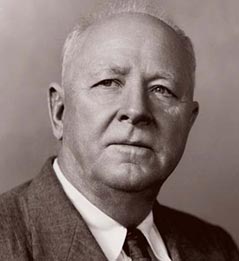 |
| Hugh Hammond Bennett |
In May of 1934 a large dust storm took soil from this area and dropped it on Chicago, New York, Boston, and Washington, D.C. Dust had to be swept from Congressional offices. 12 million pounds of soil fell on Chicago and that winter red snow fell in parts of New England.
The problem was bad enough that by 1935 the Resettlement Administration was started. The main goal of the RA was to take people from failing cities and rural areas and place them in government built 'greenbelt' communities. The idea was to 'jump start' life for those most ruined by the Depression.
There was also a media wing of the RA. Roy Stryker's Photography Project, Film Projects by Pare Lorentz and Virgil Thomson, and Sidney Robertson Cowell's folk song recordings were all funded through the RA.
Below is Lorentz' 1936 film The Plow That Broke the Plains in its entirety. It's 25 minutes, but worth your time:
Lorentz' other film The River is also worth a look. It focuses on the Mississippi River and the environmental destruction from over farming and building on its banks.
I've been reading Timothy Egan's great book The Worst Hard Time. Published in 2006, the book formed the basis for Ken Burns recent PBS documentary The Dust Bowl.
Egan's book focuses on a few families and follows them from settlement, through the wet prosperous year and then into the 1930s and the great environmental catastrophe. One of his main 'characters' is Bam White, a half Cherokee/Apache ranch hand who tries his hand at farming. He is the featured plow man in The Plow That Broke the Plains.
 |
| The Ogallala Aquifer |
The people that do still live in the area have tapped the Ogallala Aquifer. It provides 30% of the irrigation in the entire US. 82% of the people who live in the area of the aquifer rely on it for their drinking water. 1.1 million acre-feet a day are drained. This is eight times as fast as the Ogallala refills. Current projections give the aquifer 100 years until it goes dry.
The overwhelming lesson from the film and the book and the 70 years between the two is that we have not learned a thing. We have pushed the land to the point of no return, healed a small portion of it, and then have redug, replanted, and repushed it back to the brink once again. Now we're taking the underground water with us.
Living in the southwest it is hard not to be frightened of a lack of water. Of a new Dust Bowl. Animals, families, towns died from the dust. We invented new meteorology around the giant dust blizzards. Doctors had to come up with new terms for the dust pneumonia that some estimates say killed 7000 people.
 |
| Dorothea Lange, Migrant Mother 1936 |
The Depression and Dust Bowl are having a bit of a resurgence. It is the economic times we live in, the environmental crisis we feel lies just over the horizon.
Read Egan's book. Watch Burns' TV show. Take a look at Dorothea Lange's RA photos. (Marisa Silver has a novel called Mary Coin coming out in March based on Lange's incredibly famous Migrant Mother).
If there is a real lesson to learn, aside from how awe-inspiring the fragility of all of this is, the lesson should be this: Be aware.
Subscribe to:
Posts (Atom)