Fragile
At the counter the man was bleeding had on dark glasses was holding himself in a way to make him invisible but he was clearly there he fumbled his wallet and struggled to see through the swollen eye and finally took his glasses off
He said he got jumped
At the counter the man was mumbling incoherent was probably drunk his clothes looked like they slept in a gutter he was picking at a large oozing wound on his arm the skin was turning white around the edges there was a smell of death in the room
He said he was bitten by a brown recluse
At the counter the man tried to say 'coffee' but his voice caught in its throat and rattled he managed to order but spilled it on the floor his head was wrapped again and again and again in white gauze his eye was shot through with red his face was purple
He didn't say anything
Showing posts with label suffering. Show all posts
Showing posts with label suffering. Show all posts
10 March 2016


28 December 2012
Confessions of a Mask
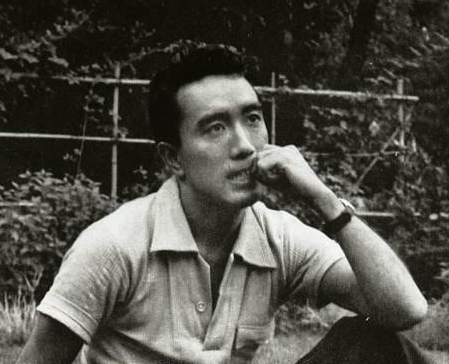
Mishima was born in 1925 and died in 1970, aged 45.
He was committed to bushido, the samurai code, and fancied himself a modern vision of that tradition. His writing is full of this 'chivalry' code, as well as death and sex.
 Due to the following of the code, Mishima was incredibly fit. Which is putting it mildly.
He is remembered for his writing, his obsession with anachronistic concepts of manhood, and his death. He and four other men staged a coup attempt on November 25, 1970. After locking themselves in a government office Mishima delivered a speech to the army below. They mocked him. He went back into the room and committed seppuku, ritual suicide.
The obsession with death played out in his books. Specifically, Confessions of a Mask (1949).
In that book we follow a young boy who feels 'different' from childhood to his early 20s. The book is told as interior monologue. We are given the boys thoughts on life and his friends and family.
 Mostly we are told that he loves suffering. The closer to being noble, or pure, the better. He also talks at length of masturbation, his 'habit'. And that he seems to only find working class men attractive. An early scene has him watching a man taking away bails of human waste. The boy becomes obsessed with the man's pants and white shirt. With the stink of work. Of sweaty bodies.
Later the boy finds a painting of Saint Sebastian by Guido Reni and basically falls in love with the image.
Mishima's book is called a novel. It is called an autobiographical novel. But I'm pretty sure it is as close to memoir as you can get. He was known to frequent gay bars, his wife was aware of it. His family sued to stop Jiro Fukushima publishing letters between the two authors of their affair. And there's this photo, part of a set, of Mishima taken before the coup attempt.

Rumors swirl that the coup was an elaborate performance on Mishima's part. That it had been planned for years as a sort of perfect, beautiful, tragic finale. All through Confessions the character discusses his eventual death. Always at a young age, always dramatic. When it doesn't come, he starts to shut off his emotions. To form the 'mask' of the title.
After a failed visit to a brothel he finds himself at a party staring at the white thigh of a woman:
Going from the book a portrait rises of a man who created his own cage. Afraid to exist, and concerned with 'correctness' to a degree that he beat bordered on obsessive he became a caricature of a man. Physically fit, adhering to a romantic ideal that never existed, and dying tragically.
The closet as performance. Society as stage.
Subscribe to:
Posts (Atom)