A fruit salad tree, developed by the West Family, who established the Fruit Salad Tree Company in 1990, in New England, New South Wales, Australia, bears up to six different fruits of the same family on the one plant. All fruits retain their own individuality, with staggered ripening times.
There are four types the company offers: stone fruit, citrus, all-apple, all-nashi. You can mix and match and even list your preference in order of the fruit you want dominant on the tree. So far only available in Australia.
3) Stoker
Oldboy is one of my favorite weird movies. Director Chan-wook Park is bringing his particular brand of awesome to the US with Nicole Kidman in tow. Stoker looks creepy. Maybe incestuous? No matter it will be bat-shit great.
I am not interested in giving O'Reilly any press. Even the small press a post on this blog would give.
As of next week this book has sat on the bestseller list for a year. It has held firm at number 4 or 5 on the list for months. So I have to acknowledge it if I am going to seriously consider these posts as looking at best-selling books.
So this book has been selling for a year. Selling a lot. There are apparently 1million copies in print. In 2012 that is a giant number.
Is it an obsession with Lincoln? Or an obsession with O'Reilly? My guess is a mix of both. I have a hard time getting any sort of excitement up about the man or this book.
What new things are there to be told of this over-discussed part of our history? Why is O'Reilly privy to these new things?
It was the first successful assassination of a sitting President. Yes, it was shocking. But does it warrant the scare quote sub-title? Especially when you consider that we had just exited a much more shocking period in the Civil War/Reformation period.
In 1835 Andrew Jackson had two pistols pointed at him at point blank range. The guns misfired allowing the President to beat his attacker with a cane. In 1864 Abraham Lincoln was riding a horse when a gunman fired at him. His horse bolted and later they found his hat with a bullet hole in it. This breach of security is way more shocking given that the shooter was only a few yards away hiding in bushes.
Yet did any of these change America forever?
O'Reilly's follow-up to this will be called Killing Kennedy. Seriously. Was that death less a change forever? I would argue that Kennedy dying at the height of the civil rights movement was way more emblematic of the time he lived in. Was way more shocking for the movement. It said that no one was safe in an America. I think that Lincoln's death was a sad end to a long war. It seemed pre-written that he would not survive. Kennedy is an odd mirror death. A sort of other end of that civil rights question that the Civil War was/was not about.
I don't think either death really changed much though. Garfield and McKinley were killed while in office. Were their deaths somehow less changing? Both of them were killed by half-craze men. Garfield by a former speech writer who wanted to be an ambassador to France; McKinley by a man who claimed anarchist ties and hoped to gain an unnamed political outcome.
I find these more shocking due to their less ideological or political-based reasons. These senseless killings. are the ones that I wish we described as 'changing America'.
I'm not saying Lincoln or Kennedy deserved to die but their deaths, the reasons behind them, they make sense. From a position of the where's and why's. These were deaths for reasons political, racial, class-based. They were deaths with sanity attached.
I'd love to see a book about McKinley in the top ten for a year.
Though I think this book is there for darker reasons.
I think it points to the great racial problem in our nation's past and it says 'this, this is where it started'. I mean that it is where the civil rights fight started in earnest. And to some this is not positive. Lincoln represents all that is great and conflicted about us. Race, politics, class. All of it.
The death of Lincoln did change America. But so does every moment in time. Every death. I think we are obsessed with the deaths of great men and women. We obsess over life cut short. We obsess over our own dark hearts, could we do the same? Will we?
I look at politics today and see the same type of faces that have always been there. The same crazed men brandish guns for the same reasons. The shooter in Norway with his vague political motives. Gabby Giffords shooting in Arizona. All of these things are the same as the other, older ones.
In essence, we have never forgiven ourselves for ourselves.
Sellers is my attempt to examine what books are topping the best-seller list and why. To talk about and understand the trends in popular writing.
Second: This new company is about fire fighters. It's about the legacy of fire fighting in America and about creating a brand that recognizes it. Think Nike swooshes for the putting out burning buildings crowd.
This 144 year-old map company has a terrible current logo, but once upon a time they would redesign it for every map they made. They started out making maps for fire insurance and moved into historic map making and modern cartography.
Here is a run down of 30 of those very awesome, really great, old logos.
20 September 2012
Over at Reuters, Felix Salmon takes a more technical approach to dissecting a book cover than I normally do. He looks at Why I Left Goldman Sachs by Greg Smith.
The video above shows Riusuke Fukahori preparing works form his exhibit 'Goldfish Salvation' that appeared at the ICN Gallery in London last winter. Fukahori painstakingly paints a layer of the work then covers it in clear resin. He then paints the next layer, and the next, and so on until he has a shockingly realistic work of sculptural painting.
You are probably expecting me to make some sort of parallel between my writing and Fukahori's work. And I easily could. The comparison is right there.
Writing is a layered process. It is slow. You add a layer and then another. Between are bits of mortar. The work is unseen, flat, lifeless, until you add that final layer of glue on top.
I could leave it there and we'd all be happy about it. But I don't think it works like that.
I view writing as a long-form game. Like history. There are maps and charts, and plans, and budgets and steps along the way. But there are also lengthy periods of not much happening. It's those moments that I think matter the most.
I don't write for half the year.
That fact alone probably discredits me to many as a 'serious' writer. As I mentioned in the first post on process, I also don't really plan. These two admissions together make me look a little sloppy in the seriousness department. I recognize this fact and I respect the opinion in it.
Honestly though, I need that time off. After undergrad I didn't write for 6 months. I panicked over it, went without sleep, spoke to my friends, my teachers, I actually thought I had 'lost it'. That mythical thing that brings the words to the tongue. I feared the death of my muse.
Then I started again. Just one day. I picked up a pen and started. And then wrote some amazing stuff for about 10 months or so. Then I broke away from it again.
And I realized after a second moment of panic that this was my method: I sponge for a bit, then spit it out.
Take my novel (the one I'm trying to get an agent for). I thought about it for over two years. And by thought, I mean had the idea sitting there. I didn't actively think on it, but it sat, collecting mind dust until I had four months free to spit the thing onto paper.
And it felt good. It felt like the right time.
Or course this method could lead to things sitting for years. To things not happening. But that happens to people who write every day also.
I did that write every day thing. I know I can. It also felt like work, like a bore. It felt like something I had to, not wanted to. It felt as wrong as a thing could. So I stopped. It took three years, but I did.
So what is my point?
That I think my process of disorganized writing is perhaps closer to Fukahori's process of painting than I initially allowed. That my process is certainly layering. That the time between layers is very drawn out as I wait for the resin to hold. That the paint looks flat, lifeless, definitely unreal. Then I add, eventually, the final layer and it pops into focus. It spins into life.
a systematic series of actions directed to some end (to devise a process for homogenizing milk) or; a continuous action, operation, or series of changes taking place in a definite manner (the process of decay)
When asked about my writing process I find that people are shocked at my lack of organization. I don't plan what is going to happen. I never have. Of course I do my research, I do a lot of it, but I don't plot structure or end points. Structure grows organically as I go. Maybe this makes me a 'bad' writer. A 'not serious' writer.
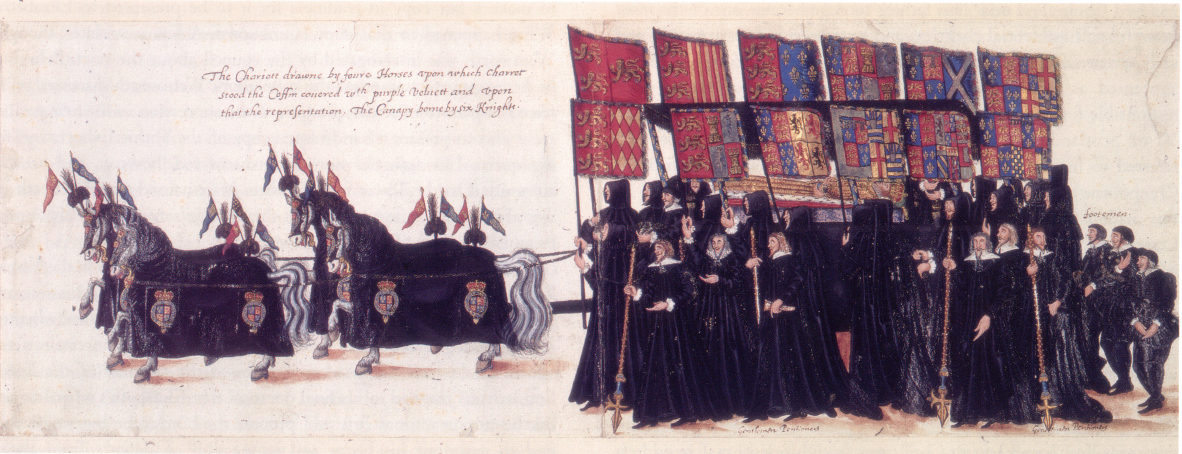
My writing is more a procession than a process. There are people/objects/events and they are elaborately clothed. They walk along some street, it may be quiet or packed with observers. There may be an object of worship being carried on the backs of those processing. There may be a queen on a seat. A virginal child to be slaughtered. A bull. They could be chanting. There is more than likely inexplicable smoke.
The crowd is moving towards a unified future. An ill-defined site of finality. That period at the end of the thought. Along the way one of them will take focus, will form relationships with the others, will enact something akin to story. And then they will find their site of period. Another will rise.
Funeral Procession for Elizabeth I
That I choose to describe my thoughts as a mob of people stalking streets in religious fervor is probably all kinds of crazy. You can tell me that to my face. I won't mind.
J recently asked me about how the writing of my second novel is going. I should catch you up:
I wrote a novel last year. I spent a full year working on it, worrying about it, caring for it. I recently started the process (that is certainly a structured set of actions) of finding an agent. It is going well but is early days. A visceral response to the process was to delve back into the world and start the second book. Eventually it will be a trilogy.
So J asked me how it was going. The outline, the acts, etc. I don't do that. I wrote the first book from beginning to end in 2 months. I wrote 10 or so pages a day. I have been editing and rewriting since then. This is how my procession works. I write something in a flush of energy. Then I stand away a bit, and stare into what happened.
Orion Nebula
It is like looking at the nebula left from nova and trying to find new stars.
Then I go in and arrange, rewrite. I emphasize certain parts, take others out. In general I try to shape what naturally happened in the initial outpour.
Do not misunderstand, I do not adhere to the wrong-headed idea of 'first thought best thought'. I adhere to a strict sense that the initial impulse creates its own momentum, that how it expressed itself was on purpose. It is a matter of finding the facets and polishing.
Did you know that some stars turn into diamonds when they die? Our own sun is predicted to end this way. At the end of the procession is a huge frozen nova core. Reflecting endlessly into space.
And that is a body of work isn't it? Millions of facets polished until they reflect the author perfectly. Of course some of us never get that far. Some do. Some leave behind cracked mirrors.
You can say that my lack of focus will impede my attempts to leave something. Even an imperfect something. And you may be right. But so might I.