Showing posts with label Re-Read. Show all posts

13 August 2012

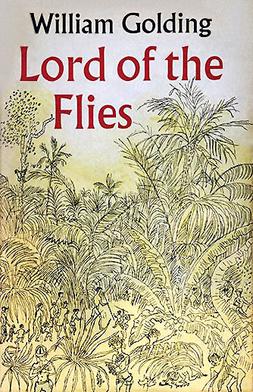
Re-Read : Lord of the Flies

First Edition 1954
Lord of the Flies
Author: William Golding
Publisher: Faber and Faber (1954)
248 pages

A pig's head impaled on a stick delivers a sermon, flies tumbling from its mouth, to a young boy.

A pair of cracked glasses held to the light of the sun.

A bleached white conch shell trumpeting through the remote island forests.

The images in Golding's book are burned into my memory. The island, the insanity that follows. The sudden interruption of rescue at the end that tacitly implies that the world as a whole is just like those boys. Loose, falling apart, afraid.

Penguin cover 1980
What I forgot, or more accurately, what I didn't see the first time I read was the clear homo-eroticism of the boys. Simon clearly loves Ralph. There are numerous scenes of arm caressing and longing looks. Ralph and Jack clearly have a love/hate relationship. They even argue like an old married couple. Piggy looks to all of them for affection and only receives abuse. They are all nearly naked or actually naked at various points and each boy is described in longing, Whitman-esque terms.

Golding's writing holds up fairly well. It is a book set in the 40s and there are certainly a lot of references that date the story, but that only made the re-read more interesting for me. The thought that these were events in the past only made it harder to detach. I had to contend with these kids going home and shaping the world we now live in.

Which is scary, but explains EVERYTHING.

If you haven't seen it, take a moment to watch the great 1963 Peter Brook film. The whole thing is on YouTube. Below is the trailer.


Re-Read is a sometime article where I go back and read a book from my childhood over and examine the threads that I find in my current adult life.

16 July 2012

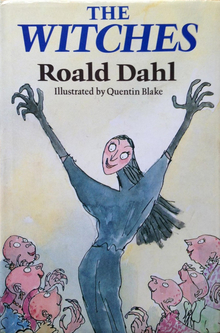
Re-Read : The Witches

The Witches
Author: Roald Dahl
Publisher: Jonathan Cape (1983)
208 pages

I was 9 when The Witches was turned into a movie by Nicolas Roeg and Jim Henson. It was 1990. It was Jim Henson's last film. If you've never seen this film, you should. Angelica Huston is great in it. And, talking mice!

Talking about Jim Henson makes me all misty-eyed and sad. It's like a very real and raw wound. At the age of 9, Jim Henson dying was like a family member dying. It was an odd first real moment of dealing with death.

The Witches is not particularly sad, but it is definitely dark and it for real touches on death more than once.

What I remember loving about Dahl is that he never once takes children for not understanding complicated concepts, like death. He assumes they understand. He expects them to. Reading Dahl is being taken seriously for the first time.

For those who've never read this book here is a quick run down. A boy is orphaned while on vacation in Norway and goes to live with his grandmother there. She tells him about witches. The parents' will requests the boy be raised in England because which is what he is used to. The grandmother and he move. Once there she becomes ill and her doctor recommends a vacation tot he seaside. Once there they uncover a plot to kill all the children in England by turning them into mice. The boy is transformed and must save the day while a rodent.

At the end the boy is a mouse and he and his grandmother decide to spend their remaining years alive fighting the witches of the world.

That ending is what I have always remembered about the book. The boy and his grandmother have a very frank discussion about her being old and probably near death. He asks how long mice live and a really sad talk about a few years follows. Both are upbeat though, because neither wants to go on without the other.

Sad and beautiful.

It gets me misty-eyed the same way talking about Jim Henson does. If I had to pick two people, who are not relatives, who shaped my world-view they would be Henson and Dahl. Henson taught me about kindness, education and love. Dahl said that was all well and good but there are dark things out there so be ready to kick their asses.

Re-reading The Witches reminded me of the simplicity of the work. And how good a writer Dahl really was. He manages to take a very basic story of children taking on the world and infuse them with a magical sense of realness. Close to what the world feels and looks like to a child. Scary and amazing.

And that's what we lose as we get older. The amazing is replaced with more scary. I think we all would do good for ourselves to remind us of the amazing. Everyone go pick up a Dahl book. Read it. It will take you only a few hours. Then go watch an episode of Sesame Street or The Muppet Movie. Then watch the video below. It will make your day better. I promise.


Re-Read is a sometime article where I go back and read a book from my childhood over and examine the threads that I find in my current adult life.

20 June 2012

Re-Read : The Great Gatsby, Part 2


The Great Gatsby
Author: F. Scott Fitzgerald
Publisher: Scribner (1925)
218 pages

Read part one here.

I tend to focus on what books make me think. The associations I have with them. The Great Gatsby is tied to high school English class. I am reminded of discussions of the green light, wanting, metaphor. All in vague flashes.

Re-reading Fizgerald's most highly regarded work I was struck at the simple beauty in the writing. The cam painting of the idle and bored rich of New England. How the time period seemed less romantic and more doomed to failure.

Gatsby is painted in heroic language. He is monolithic, everything Nick wishes he were; rich, handsome, amazing war-time back story. Daisy is bored with marriage, seems to not even remember having a child, is mostly a child herself. Nick is a blank slate for these two to play out their odd romance upon. To heft the weight of morals at so they can get to doing.

And Nick is racist, classist, and ultimately wishes he were vapid and having fun like these people he is watching collapse in front of him.

To say that Fitzgerald gives us a in detail death of a star. An implosion. The untenable world of the 20s could only collapse, and the resulting nova destroyed lives. But that final line about boats drifting "against the current, borne back ceaselessly into the past" is a warning and prophecy. The collapse would destroy lives, but America would seemingly not learn the lesson. At least not the protected rich and soon to be rich.

Fitzgerald's writing is sharp, pointed and crystal. There is a reason this is his 'great' book. It is short and to the point. He doesn't mess around. He tells the story and gets out. I dislike every character in the book, but the plot and pacing are the best of noir writing. I'd say it'd make a great movie, but it has been proven a few times to not make a good film.

J.B. is on the case.
A movie can only hope to give us spectacle. While Gatsby is many things, romantic is not one of them. The affair is oddly cold. The dialogue cursory. Gatsby lives and breathes in descriptions, asides, pauses. Otherwise it's a potboiler about a death in a swimming pool. Which I'm sure was an episode of Murder, She Wrote. And that would make sense, there was another creation about upwardly mobile people meeting tragic ends set in New England.

The book needs to be inside Nick's head to work. The reader needs to be that slate Gatsby and Daisy draw upon so that in the end that feeling of universal awe is reached. That we as a country, as a whole, are drifting in hapless fear of the future and doomed to repeat our mistakes.


Re-Read is a sometime article where I go back and read a book from my childhood over and examine the threads that I find in my current adult life.

18 June 2012

Re-Read : The Great Gatsby

The Great Gatsby
Author: F. Scott Fitzgerald
Publisher: Scribner (1925)
218 pages


As I write this the 7 hour 15 minute long staged reading of Fitzgerald's 'greatest' work is playing in London's West End at the Noël Coward Theatre as part of the annual LIFT Festival.

I mention this merely as a starting point. That this production, Gatz, created in 2006 by Elevator Repair Service, exists at all is telling of so much of Gatsby's allure. And of its failings.

We all know the story: Gatsby is a rich man, Nick is not. Gatsby pulls Nick into a world of opulence and wonder. Gatsby loves a married woman. That woman's husband is also engaged in an affair. It all ends terribly. Nick goes back to reality.


That is the trailer for the Baz Luhrmann movie, out this Christmas from Warner Brothers! In 3-D! Which begs the question: Why Gatsby? Why now?

In a recent Sellers post I touched on how I think our attraction to past eras of perceived glamor seem to coincide with periods of economic downturn. In that post I was focused on the Tudor period. I touched on 20s and 30s fashion making a comeback as well as the re-emergence of Dallas in that post. We have a strange cultural blind spot for certain eras; the 1920s, 1950s and apparently Tudor England.

Nostalgia overwhelms reality.

Tudor England was not sexy. It was political havoc and many (most) were killed in the process. And that is what is interesting about why we seem to be having a Gatsby moment. The 20s were dark, full of crime, and led to the Depression. The book is racist, classist, and sexist. The characters are unlikable, rich, white, and many die or end up in a sort of arrested development because of their wealth or 'position' in society.

So are we feeling like the 20s represent the early 2000s? Are we trying to explain our situation through the past? That's interesting because of how the book ends:

He had come a long way to this blue lawn, and his dream must have seemed so close that he could hardly fail to grasp it. He did not know that it was already behind him, somewhere back in that vast obscurity beyond the city, where the dark fields of the republic rolled on under the night.

Gatsby believed in the green light, the orgastic future that year by year recedes before us. It eluded us then, but that's no matter - to-morrow we will run faster, stretch our arms farther...And one fine morning -

So we beat on, boats against the current, borne back ceaselessly into the past.

This is one of the greatest closings in American writing. I would argue this is why the book is still around. Why it is read and loved. This final passage takes what is a basic pot-boiler and twists it into a cautionary tale against vapid wealth, against nostalgia. We are held by our past and that hold will destroy us. In large or small ways.

I will go into my views of how reading this book now vs. high school felt in part two of this post.


Re-Read is a sometime article where I go back and read a book from my childhood over and examine the threads that I find in my current adult life.

21 May 2012

Re-Read : Flowers For Algernon

Flowers For Algernon
Author: Daniel Keyes (1927)
Publisher: Harcourt, Brace & World (1966)
274 pages

What do you remember about this book? Probably two things. 1) That it is about a man who has his intelligence increased through science; and 2) There is a mouse and it dies.

What I forgot about the book was that the main character, Charlie, sexually assaults a woman in Central Park and spends a good portion of the book drunk and moaning about the world around him. I forgot that the book is written as journal entries of Charlie's and that the form of the book follows the progression of the character's level of intelligence.

Dr Strauss says I should rite down what I think and remembir and everything that happins to me from now on. I dont no why but he says its importint so they will see if they can use me. I hope they use me...

That is the opening to the novel. The story was also published as a short story in 1959. That shorter version is what most junior high students read. That main difference is that the novel dwells on Charlie's decent into alcohol and sex a little longer.

What is interesting about the form of Keyes book is that it directly follows the narrative. As Charlie grows in intelligence after his operation the writing becomes clearer, in higher diction. He even discusses his finding of grammar and punctuation:

Today, I learned, the comma, that is, a, comma (,) a period, with, a tail

And the next day:

You, got. to-mix?them!up: She showd ? me" how, to mix! them; up, and now! I can. mix (up all? kinds of punctuation - in, my. writing!

Compare this to the later entries:

Nemur, Strauss, Burt, and a few of the others on the project were waiting for me in the psych office. They tried to make me feel welcome but I could see how anxious Burt was to take Algernon, and I turned him over.

Keyes has managed a book with form and function in harmony. The book is definitely worth a re-read though. It is beautiful and sad. It manages to be cautionary without being too preachy. That said, there are a ton of ham-fisted moments though. Anytime Charlie is put into a situation with a woman it turns into awkward 1950s theater and the men are painted in more detailed strokes then the women. The women are lust/pity objects for Charlie to play his psychology off of.

Which makes sense. Keyes got his start at Timely Comics which would change into Atlas Comics under Stan Lee. Atlas is the company that would one day become Marvel. Keyes wrote horror comics at EC in the mid-50s. HIs background is in short-form action/horror/sci-fi with clear good guys and bad guys. Little gray areas. That Flowers for Algernon is as good as it is, and holds up, is a bit of a miracle.


The clip above is from the 1968 film Charly, based on Flowers for Algernon. Cliff Robertson won an Oscar for his role as Charly.


Join me in the discussion. Next Month : The Great Gatsby.

Re-Read is a sometime article where I go back and read a book from my childhood over and examine the threads that I find in my current adult life.

23 April 2012

Re-Read : A Wrinkle In Time

First Edition 1962.
A Wrinkle In Time
Author: Madeleine L’Engle (1918-2007)
Publisher: Farrar, Straus and Giroux (1962)
238 pages

There is a moment as a kid when your mind expands. When you suddenly are aware that the world stretches beyond your home and family. That the universe is expansive, science is weird, space is amazing.

For one shining moment everything is possible.

This book was a huge part of that for me. I have a love of knowledge, science, the beauty of imagination. I can trace these to moments in Madeleine L'Engle's amazing 50 year old book.

And after all that time there is still a lot to love here. There is the absolute love of science, intelligence, and learning. L'Engle infuses her characters with a profound smartness without apology and without cliche nerdiness.

80s kids know this version.
There are the imaginative characters of Mrs Whatsit, Mrs Who, Mrs Which, and Aunt Beast. The Murry children are all well defined. Charles Wallace alone is amazing if for nothing else his clear aspergers representing.

The settings are epic. Camazotz and its strange bureaucratic nightmare office buildings is something out of Orwell. Even the evil of The Black Thing and IT are ominous in a classic vague/scary way that calls to mind the best of allegorical writing and Lord of the Rings.

The beauty is still there. The sense of wonder. All intact.

Coming back to it as an adult I was amazed at a huge part of the book I completely missed as a kid.

Here is what I mean. When Meg heads off to defeat the IT at the the end of the book the Mrs Ws give her 3 gifts:

  1. Mrs Whatsit - her love
  2. Mrs Who - A Bible quote about the foolish confounding the wise and the weak confounding the strong
  3. Mrs Which - she tells Meg she has something IT does not

All reasonable gifts that are - whataminute!? - Bible quote?

As a child reading A Wrinkle In Time the book was about being a kid, having an imagination, space travel, and science. It was kids kicking bad guy butt and saving the world. The book is about those things but it is also about religion.

I would not classify this a 'religious' book. The moments mentioning the Bible are really meant as allegory, as story-telling, and they don't really change the actual story. They could be left out and little would be damaged. Which I guess is my point. They don't serve a purpose beyond being Bible references tossed out to the world to show religion has a place. We are told that Jesus fought IT along side Ghandi and the Buddha and all are considered equally good. But the Bible is the only thing quoted from.

L'Engle says that science, art, and religion have a place together which is great. The book does little to connect any of these things. While that may be a huge undertaking for a 'kids' book, I would point you to His Dark Materials as a series that deals with religion, science, etc. in a very frank, albeit different, way.

The main evil L'Engle gives us is a giant brain. Pure thought is the 'evil' presented in this book. What is the takeaway? That thinking is only good if it is infused with religion, specifically Christianity.

I don't think that L'Engle was being malicious. The book is a clear product of its time and place. 1960s America was a strange blend of anti-Communist sentiment, cold war crazies, and general conformity mixed with hyper-patriotism and religion. It was not a place for anyone to question anything openly. Which is probably why even this book has been banned many times throughout its 50 years despite being firmly 'safe' in all of these regards.

My biggest problem with the book is a problem I see across the genre. Why are children's books full of characters who lack agency? Why does Harry Potter do absolutely nothing the whole of 7 books while others pull strings and die for the cause? He doesn't even kill Voldemort at the end. The wand Voldemort uses reflects the spell back at the villain. Why does Katniss have to remain above the frey in Hunger Games? She drops wasps, she mercy kills the already dying, she kills one who just killed a very young child. I guess I should be happy she at least participates in some way.

I'm not asking for bloodthirsty lead characters, but if you set up a world where Harry is going to have to fight a war against Voldemort then have him basically sit there while every one else does that thing...you have failed at story-telling. If your world is children conscripted into killing each other and your main character wins that contest by mainly sitting in a tree and surviving off of berries while others brutally kill you have not shown the horrors of said world.

Similarly. If your premise is that a father has been kidnapped by ultimate evil and your brother is controlled by a giant disembodied brain...I don't expect machetes and blood letting. I do expect something more than a deus ex machina and a pat love is good coda.

I know the book is meant to be allegory. But still, even in allegory the center would still have to hold. The story would adhere to its world.

Newest cover from 2007.
I find it troubling that we tell our children stories where they are asked to move heaven and earth but given no agency to do so. You do not solve problems with love alone. It is a false premise. It sets up children for a moment after the one I opened with. A moment where they look at the world and it shrinks. Where they lose the magic they were promised. The love they have proves useless against 'evil'. They loose hope. They settle. Why be an astronaut when you can work for an insurance company?

I think we should trust ourselves more. If we can stomach a world with evil, we can stomach a world where we fight that evil and do so without remaining above the dirt and shit of that battle. We can have the magic and wonder and the reality. All of it.


Re-Read is a sometime article where I go back and read a book from my childhood over and examine the threads that I find in my current adult life.