Showing posts with label race. Show all posts

13 November 2016

Poem-A-Day #258 : Species Complex

Species Complex

.
There a body
orange black under sodium-vapor light

Eyes a void
                    don't look in the void

What colors the body
in day

.
The butterfly
lands on the drying plant

It is November why is this thing living

Wings fold unfold
                    scales are enormous eyes
that move
like snakes entering narrow spaces

They are liquid

The impulse to bathe in the copper wetness is unbearable

.
It is easy to say - we are all the same - without enacting it

Language is a seed
                    it will sit dumbly on the pavement until watered

Language is a turbine without water
a magnet
                    coiled in copper wire
left to collect dust

Feel the sound of water through the tunnels of the dam

The turbines long to be harnessed to it - they rub themselves raw
in this longing

.
Sound of buzzing

The body
                    yellowed - like paper - always everything reduced to paper

There is a thing in that
a sort of comment on ledgers and graphs and the way our lives are grid-ed

On every corner a lamp destroys the color of the world

Sepias the entirety

The body and the other body
                    every body

Jaundices - lands on the dying milkweed
growing between the sidewalk joins

Hums

Corrects pitch until in line with the light


Repeating Patterns of Mimicry (2006)
Axel Meyer

07 September 2016

Don't Breathe


*
Water scares the shit out of me.

A day on a boat. Swimming in a lake. Spending time at a pool. These things do not calm me. To this day they call up a set of pre-made plans of escape.

The fear manifests in subtle ways.

Because I couldn't handle water in my face I insisted on baths until well into my teens.

The ocean is almost too much water to be afraid of so I can be near larger bodies of water without too much of a problem. I can even wade into water a bit. My height allows me to get fairly far out before I become buoyant. It isn't until then that the concern kicks in.

I'd be terrible on a cruise and have often thought about how I would deal with that situation. None of them are good solutions as they usually involve hiding from windows and fresh air.


*
I love horror movies.

The more full of tropes the better. I live for the moment when victims go up the stairs when they should go out the door. When they don't check to see that the villain is dead. I love trying to guess who will be the 'last girl' and who will die first.
Fede Alvarez
Photo by Gage Skidmore

It's a game. It's silly. It rarely scares me for real.

This evening I saw Don't Breathe. The movie was directed and written by Fede Alvarez. He also was responsible for the surprisingly good remake of Evil Dead from 2013

The premise is deceptively simple: three thieves enter a house owned by a blind vet to steal his money. The vet is not what he appears.

Where the movie enters into greatness is in how the premise reveals itself and plays out.

This is a brutal movie. It does not relent. The final act manages to up the ante of the film while subtly referencing horror tropes.

And it does this without being overly gruesome or falling into the pitfalls of torture porn that has ruined a lot of horror films in the years after the successes of the Saw series.


*
This circles around a question that I have about horror movies.

What scares us?

I'm sure that you have an example like mine. But these things are not what I'm actually interested in. Most horror movies don't actually depend on the things we are really afraid of. They play off making us jump and our natural inclination to be turned off by gore and death.

What I'm thinking about though is more what scares US. Collectively and culturally. What are WE afraid of.

Horror doesn't always feed off of cultural fears. But they inform it. The 80s were full of films featuring nameless, powerful, murderers coming after groups of beautiful youths. These fears can easily be tied to cultural fears of lawlessness and cold war fears of the 'other'.


*
Don't Breathe is set in Detroit. Most of the movie takes place in a lone house in an otherwise abandoned neighborhood.

It Follows was released in March of 2015 but made its way slowly into theaters. The story is, again, deceptively simple. A monster chases a young woman and wants to kill her. What sets it apart is that the monster is sexually transmitted. You have to fuck your way out of the death. This is a pretty good upending of the classic trope from 80s movies where the people who have sex usually die early in the movie.

The two movies both use traditional tropes to both utilize them and to break them. Though they do this while maintaining tension and refusing to make fun of the genre.

These are not the Scream movies. There is not an attempt to undermine or mine the genre.

Did you notice that both are set in Detroit? It's key to what I think scares America most in 2016. We are not afraid of terrorism, immigration, or any of that.

We are afraid of collapse.


*
Since the 1950s Detroit has experienced a 60% drop in population and even though the metro area of the city still has 4.3 million citizens Detroit has become the poster-child for what happens when an economy collapses in the 21st century.

This is what scares us.

The idea that a once-prosperous and important place could become unimportant and less wealthy goes against everything that American Capitalism promises. It proves us fallible. It says that the American Dream has cracks in it.

Setting these horror movies amid the collapse is a cunning representation of a new fear. The creature from It Follows and the vet from Don't Breathe also have faces. They are not the masked monsters from the 80s. They are people who look normal. They are us responding to collapse.

Interestingly, both movies also focus on white protagonists. And both manage to show a Detroit void of minorities. So it is not just collapse in general but specifically white collapse that is the source of fear. Don't Breathe renders this in literal terms with a brief appearance of a white supremacist. Both films also point out that the 'bad' parts of town are not where our protagonists live. They are not the white parts.

The danger is in the collapse. The breaking. And in the breaking the real danger is in what we do in response.

Do we retreat into our corners and stare at each other in fear. Lashing out when one comes close to us.

Or do we try to build something new.

30 May 2016

The Blank Screen

Jason Shulman - 2001: A Space Odyssey

The above image is a time elapse photo of Stanley Kubrick's 2001: A Space Odyssey. It takes a familiar medium, film, and renders it unintelligible. There are objects within the image, but holding them for long becomes tenuous.

English photographer Jason Shulman has been getting a lot of press lately for these images. It began, as far as I could tell, with a piece in Wired on May 9th. From there, the story has been 'picked up' by various reblog sites. This trend of posting another sources news to your own website as if you came up with it is an odd internet for of the Associated Press that I'm both ok and really wary of. But that's another discussion.

J.M.W. Turner -
Rain, Wind, and Speed - The Great Western Railway (1844)
The images are beautiful. They recall the works of J.M.W. Turner, I have professed my love before.

In some of the photos you can make out distinct images from the movies. The above 2001 image, for instance clearly showcases the red light of Hal at the center of the frame.

And while they most strongly resemble Turner or more abstract painters like Rothko or even Pollack, I was immediately struck by an omission from the discussion.

From the Wired article:
Shulman lives and works in London, and typically creates sculptures. During the Sochi 2014 Winter Olympics he decided to test an idea he had about photography, which basically involved shooting the Games without going to Russia. He trained a camera on his television and took long exposure photos of athletes in motion. Most of the events he recorded were brief, leading him to wonder what might happen if he shot longer stretches of action.
And I don't doubt that this is the inspiration that Shulman's idea originated from but...

Hiroshi Sugimoto - Akron Civic Theater, Ohio (1980)

This is a photo by Hiroshi Sugimoto taken in 1980. It is a long exposure of a movie screen playing a movie. As a result of the black and white film and long exposure the screen becomes a clean white omnipresent eye hovering over the audience that appear, albeit as nearly unrecognizable smears in their seats. He started this series in 1978. His description:
Different movies give different brightnesses. If it's an optimistic story, I usually end up with a bright screen; if it's a sad story, it's a dark screen. Occult movie? Very dark.
The Guardian ran a great gallery of this series on March 1 of this year.

Interestingly both the National and Tate galleries in London have Sugimoto pieces in their permanent collection. And there was a full exhibit of his work in 2004 at the Serpentine Gallery. Also in London. Where Shulman lives.

Hiroshi Sugimoto - Lightening Fields 128 (2008)
Now. I'm not calling this stealing. I'm not even going to really blast Shulman because artists can and should find inspiration where it lies and I don't think this is malicious or intentional.

Inspiration comes odd, when it comes. And it's not always clear even to the creator where the seed idea came from. And that's what I'm guessing occurred here.

Shulman can be excused for not knowing a photographer since he works mainly in sculpture. I don't know every writer, so I'm going to give him a pass.

The people writing articles about him on the other hand. These are people paid to look into topics. A quick search online brings up Sugimoto's work. And that work was featured in Wired in 2014. Sugimoto's work has been in Wired at least 5 times, the most recent one in January of this year. So I don't blame Shulman. I blame bad reporting.

Because Sugimoto's work is really well-known. His experiments in photography are diverse and well-documented. He spent a few years shooting electricity at photo-sensitive panels. He photographs wax figures in a way to make them look like living people. He's an odd dude.

Hiroshi Sugimoto - Fidel Castro (1999)
And that's the problem.

In all of this press about Shulman and his movie photos there is not one mention of Sugimoto. A Japanese man who has spent the better part of 60 years innovating and experimenting in his genre.

Let me be clear. Both works can, and should, be praised. They are working towards different ends. Shulman seems interested purely in what each film looks like filmed this way, in the aesthetic of the result. Sugimoto is interested in everything but the movie. He is interested in the rooms, the people, the eeriness of sitting in a room staring at nothingness for a few hours. He is interested in the time it took to film it, what it says about that time.

And this is where I will say something bad about Shulman. One of these artists is creating works that ask us to inspect ourselves and out space. The other is making a pretty picture.

20 May 2016

Poem-A-Day #81 : Colonization (after Calvin Trillin)

Colonization (after Calvin Trillin)

Have they run out of provinces yet?
If they haven’t, we’ve reason to fret.
Long ago, there was just Cantonese.
(Long ago, we were easy to please.)
But then food from Szechuan came our way,
Making Cantonese strictly passé.
Szechuanese was the song that we sung,
Though the ma po could burn through your tongue.
Then when Shanghainese got in the loop
We slurped dumplings whose insides were soup.
Then Hunan, the birth province of Mao,
Came along with its own style of chow.
So we thought we were finished, and then
A new province arrived: Fukien.
Then respect was a fraction of meagre
For those eaters who’d not eaten Uighur.
And then Xi’an from Shaanxi gained fame,
Plus some others—too many to name.

Now, as each brand-new province appears,
It brings tension, increasing our fears:
Could a place we extolled as a find
Be revealed as one province behind?
So we sometimes do miss, I confess,
Simple days of chow mein but no stress,
When we never were faced with the threat
Of more provinces we hadn’t met.
Is there one tucked away near Tibet?
Have they run out of provinces yet?


  • This piece is an erasure of THIS poem by Calvin Trillin that appeared in The New Yorker in April of this year. The poem is, at best, tone deaf. To say the least.
Source - The New Yorker

11 April 2014

Review : The Boss

Author: Victoria Chang
Publisher: McSweeney's
Date: 7/2013
64p
When the world breaks apart beneath you there are only a few choices available – to pick it up and carry it with you – or to throw it away, abandoning the mess. That mess exists either way. The question is about who and when it gets dealt with.
Victoria Chang’s new book dredges the rubble of both kinds. That of family. And that of society. The family plays out in an examination of her father, suffering from dementia. In the study of her own life in terms of who is boss and who is not. Her actual boss at work, herself vs. her daughter, her father.
Society enters in the form of 9/11. In strange, subtle ways, the event creeps in. The experience of an emigrant in America. Of a family integrating into the culture.
The poems begin in a place of thought. A cascading train that opens quickly into nature, aging, and death. The progression is one of language to senses. The words drill down the page. A sort of cultural tunnel-making. They start from a sense of now and dig quickly into pasts personal and public as they work down the page.
The form is ballad-like. The strong sense of meter and internal slant-rhyme drives the words quickly. There is little time to think, to absorb. The drive to go from start to finish is almost oppressive. Chang is the boss here. The control is astounding.
The healing power of voicing a broken history is important. One of reconciling the past and present. Talking seems central to the process.
my four-year-old daughter still listens to me I am the boss and I like it I see why the boss likes it
Conversations with an ailing father. Where he confuses her for her sister. The forgetting of time. Thinking he is still working. The conversation as her boss comes back to work after having a baby. Each moment seems to be a way into a wound. A filling.
When 9/11 first shows up it is sudden, it is a question to be answered. But the answer is never given. We watch as it happens. We see pilots merging with bosses on the 54th floor. We ponder children being too young to save parents.
Chang uses acrostic poems built around Edward Hopper’s paintings of offices and urban streets to discuss the ambiguities of human interaction. To point out the many interpretations of a frozen scene. The ambiguities in every day life. Here the question of boss melts, each time a different person is given the title. Americana is reinterpreted as the immigrant experience.
The Boss concludes with a recount of the Tōhoku earthquake on March 11, 2011. We are left at the mercy of a higher boss. Nature. And the concerns of man seem to dwindle. The problem of an ailing father is left in that space. Nature does as it will. The concerns of the office and who is in charge when are abandoned finally. The earth cracks open and water rises. People fade, people rise. They lead, then everyone, everywhere falls.
A final unavoidable breaking.

05 April 2013

Manhattan on Fire

© 2002-2013 The Lincoln Institute
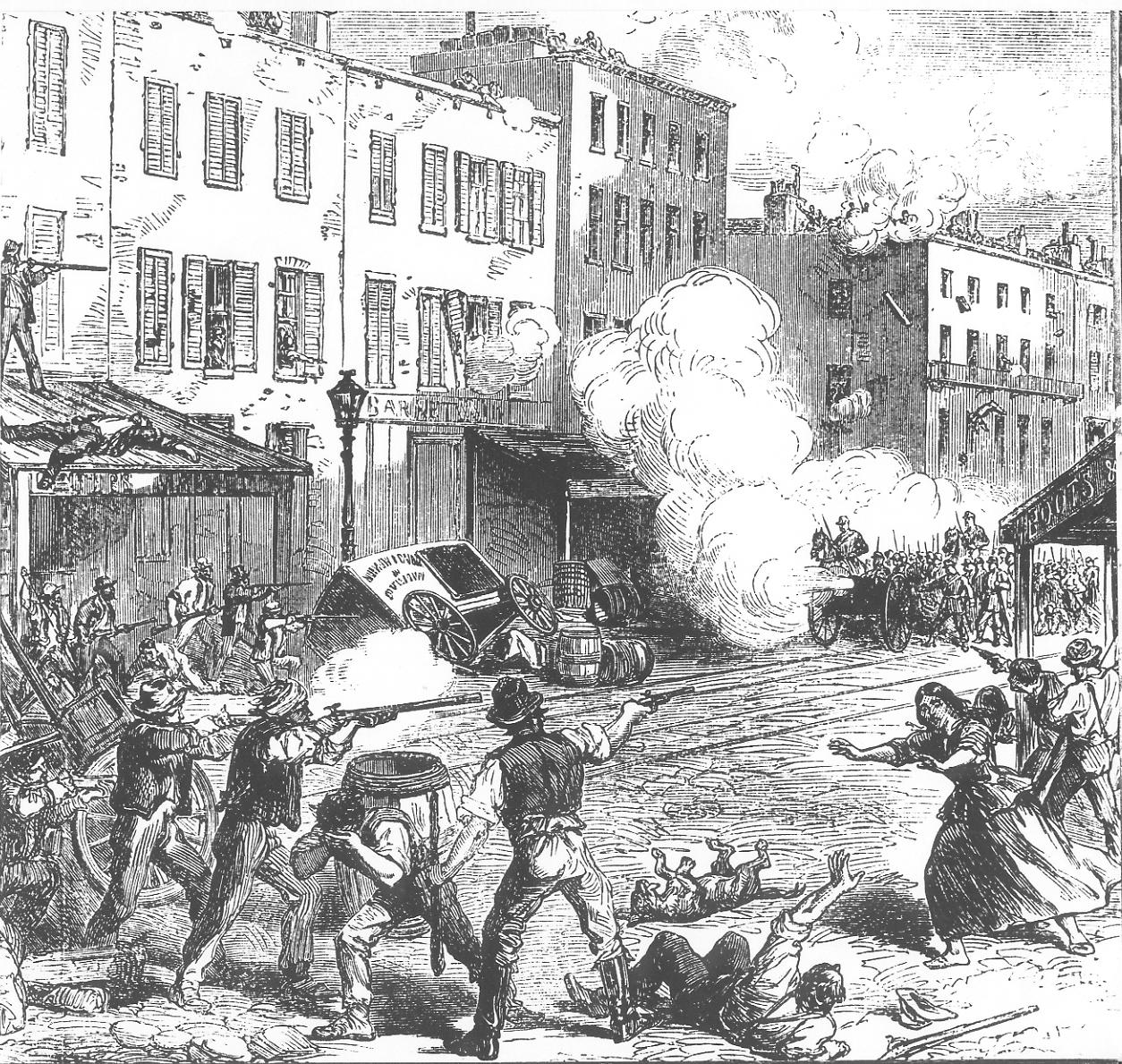
July 11, 1863 was the day that numbers were first called in the military draft for the Civil War. Even though there were rumbles of protest, the calling of numbers went peacefully.

On the 13th the numbers were again called. An angry mob of around 500 people showed up at the Ninth District Provost Offices at Third Avenue and 47th Street in Manhattan. The draft was halted as the building was set on fire. Rioters stopped the fire fighters from putting the blaze out. Horses were killed and street cars were toppled. The city cut telegraph lines to keep the news from spreading that a large group of mostly white Irish New Yorkers were rioting against Emancipation.

The fear was that there would be no jobs for the white men.

Because of the war, there was no militia to be sent into the city. The mob turned against the black people of New York. The mob beat, tortured and/or killed numerous black people, including one man who was attacked by a crowd of 400 with clubs and paving stones, lynched and set on fire.

Particularly terrible was the destruction of the Colored Orphan Asylum at 44th and Fifth Ave. 233 children lived in the building when it was attacked by several thousand rioters. The place was stripped of food and supplies before being set on fire and burned to the ground. Amazingly each of the orphans escaped.

At least 100 black Americans were killed on the first day of rioting. Many black-owned businesses were burned.

The homes of politicians who supported the Emancipation were attacked.

By July 16th at least 120 people were killed. 11 black men were lynched. At least 2000 were injured. Property damage was $15 – $75 million (adjusted for inflation). 50 buildings burned to the ground and many more had to be demolished from the damage. Whole sections of the city were altered overnight.

As a result of the violence many blacks moved to Brooklyn,which was still a separate city, and New Jersey. Whites and blacks would be divided by boroughs for decades. This division can still be seen in parts of the city to this day.

The riots are considered the largest civil insurrection in American history. Ever.

What amazes me the most about this event, aside from it happening at all, is that I never knew about it. That something so important to the history of this country occurred and no one pointed it out in my many years of school.

That while a war that deeply divided our country was going on, our largest city was also deeply divided - to the point of killing 120 people - and we don't discuss it...

I can only look at is and say that this is part of our problem. Part of New York City's larger racial and political and class-based problems. Deeply hidden beneath daily lives, all over the country, are these hidden pasts.

I don't know if we can unearth and put to rest enough of them to actually heal. I don't know that the wounds heal themselves. But it's interesting that we don't acknowledge that the wounds are there.

You can read more about the riots at Mr. Lincoln & New York. A larger version of the map at the start of the post is here.

23 January 2013

A Problem

I had a long talk with JG today about the resurgence of the black servant in media. Movies like The Help, Django Unchained, and the upcoming The Butler. Our discussion was focused on the inability of America to face our past discretions.

We are a country of teenagers. We crash our car while drunk. Our parents are indignant and ground us for a month or two only to give us a much nicer new car after the punishment.

That simplifies the problem but we have an inability to discuss these things. We look at films like Django and wring our hands, but is the message being absorbed? We acknowledge the problem but do nothing to fix it.

I wondered aloud if we even notice the problem. Isn't there a possibility that some see a film like Django or The Help and think that these problems were in the past? That we already did that civil rights thing?

I have the same issue with Zero Dark Thirty. A film that talks about important issues. America has spent 12 years fighting unwinnable, money draining wars. And what have we gotten in return? Bin Laden is dead, but do we feel better? Do those 3000 people come back?

The final shot of ZDT is of Jessica Chastain, alone on a military plane. Her face takes up the whole of the frame. She has just 'won'. She got Bin Laden. She saw his body. Her face twists and she bursts into tears. The battle that she waged for 12 years has left her hollow and destroyed. She has lost her friends. She has spent all her time and energy 'getting' this man. And for what?

At one point in the film Chastain tells a marine that he is there to get Bin Laden for her. To kill him for her. She says she was left alive to get Bin Laden. Clearly, the character becomes a stand in for all of America at this point. We are the lone woman, spoken of as being 'young' and 'fragile'. We are the one left standing, we are there to dole out vengeance.

Kathryn Bigelow has come under considerable criticism for the portrayal of torture in the film. I can't help but feel like the critics are just incapable of stomaching the truth of what America spent 12 years doing.

I conflate these two types of not dealing. Race and War. The arguments for and against each are more nuanced than what I have glanced at here. I can't help but feel that we suffer, as a nation, from PTSD around both of these issues.

We avert our gaze from what causes us nightmares.

Sometimes we acknowledge the events. But only in certain terms.

Disney won't release Song of the South on DVD in the US. It is widely available in the rest of the world. We spend more time discussing whether Tarantino can make a movie about slavery than what is int he movie. Bigelow is called out for historical inaccuracies and the ambiguity of her 'statement'.

We are doomed to spin our wheels. To repeat.

Octavia Spencer won an Oscar for playing a sassy maid in The Help. The first Oscar won by a black actor was in 1939, when Hattie McDaniel won for playing a sassy maid in Gone With the Wind. I think Spencer is a great actress, but is this the best we can do?

07 December 2012

Lose Your Mother

Poetry readings and I don't always get along. I find them tiring. I communicate better with words on page than in the air around me. Listening for more than 20 minutes and I get a bit ADHD and start to examine the walls of the room I'm in for peeling paint.

First image from a search - 'poetry reading'
I have a similar problem with music. I don't really absorb lyrics while listening. Not in a 'I understand the thesis of the song' kind of way. More in a 'words are happening' kind of way.

Tonight, J and I went to a great poetry reading at Collected Works in downtown Santa Fe. Muse Time Two is a series that pairs a local NM poet with a wider-known more established writer. The pairings often illuminate each authors work. I like the idea.

Tonight's reading was by Connie Voisine and Martha Collins. Voisine is the director of the writing program at NMSU in Las Cruces. Her poetry was beautiful.

Collins read from her books Blue Front (2006) and White Papers (2012). They are companion books about race, specifically race from a white American point of view.

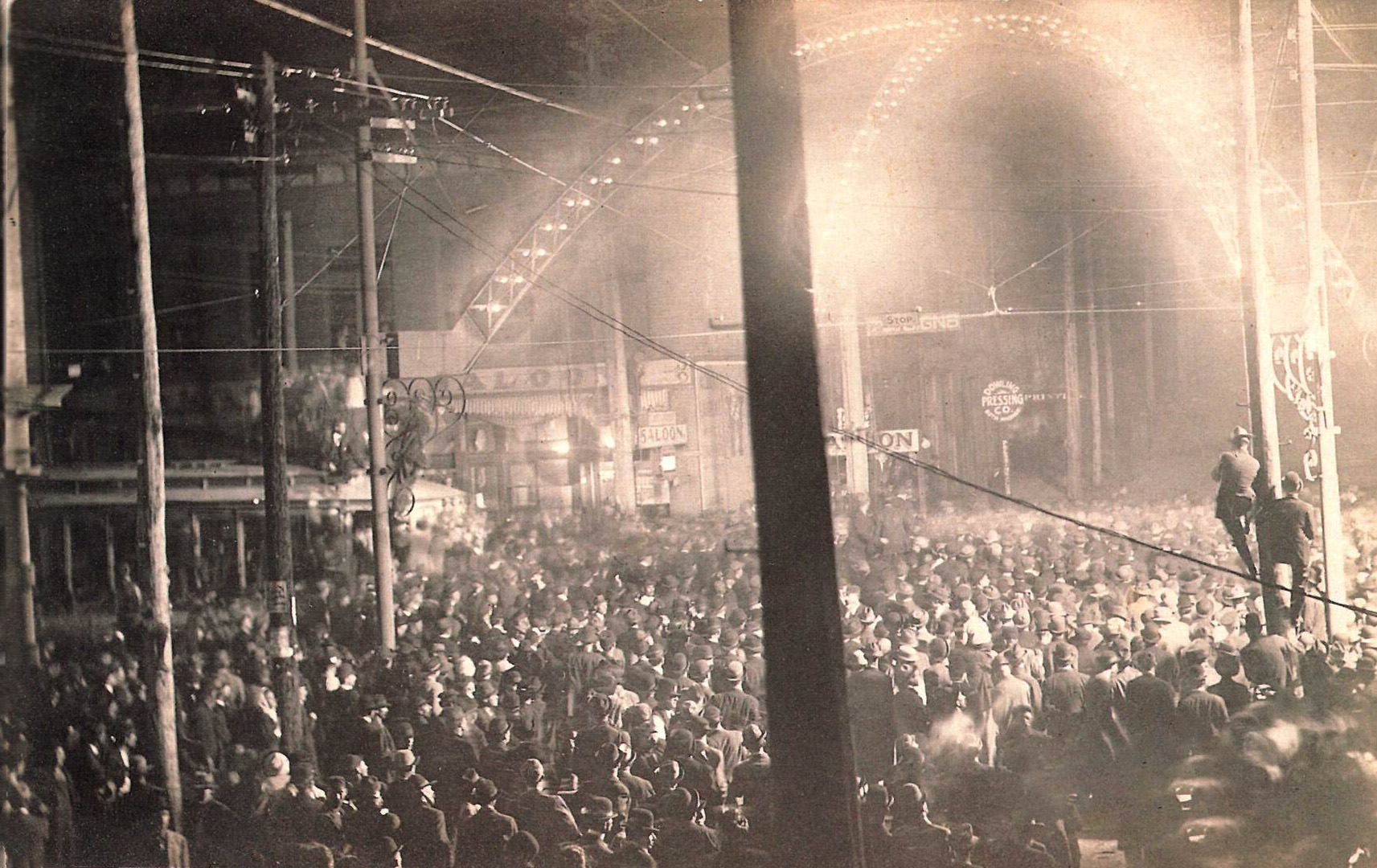
Blue Front seems to be the stronger of the two books. It is centered around Collins' father witnessing the hanging in 1909 of Will James. There were 10,000 participants.

I want to let that number linger for a second. 10,000 people helped hang someone in 1909 in Cairo, Illinois in front of a restaurant named the Blue Front. In front of a 5 year-old boy. Below is a photo of the event.


The poems Collins read were a little too disjointed, a little too knowing. There was an aura of self-consciousness. Too aware of the topic. Obviously you are aware of it, but it was all a touch too blunt. Too 'white liberal guilt'. The moments of brilliance came in the unanswered and cut off questions. She had an entire poem with each line starting 'Because...' and not a one had an ending.

My stumbling into Collins poetry is an interesting coincidence. I just read Lose Your Mother by Saidiya Hartman. A similar examination of race but from the other side.

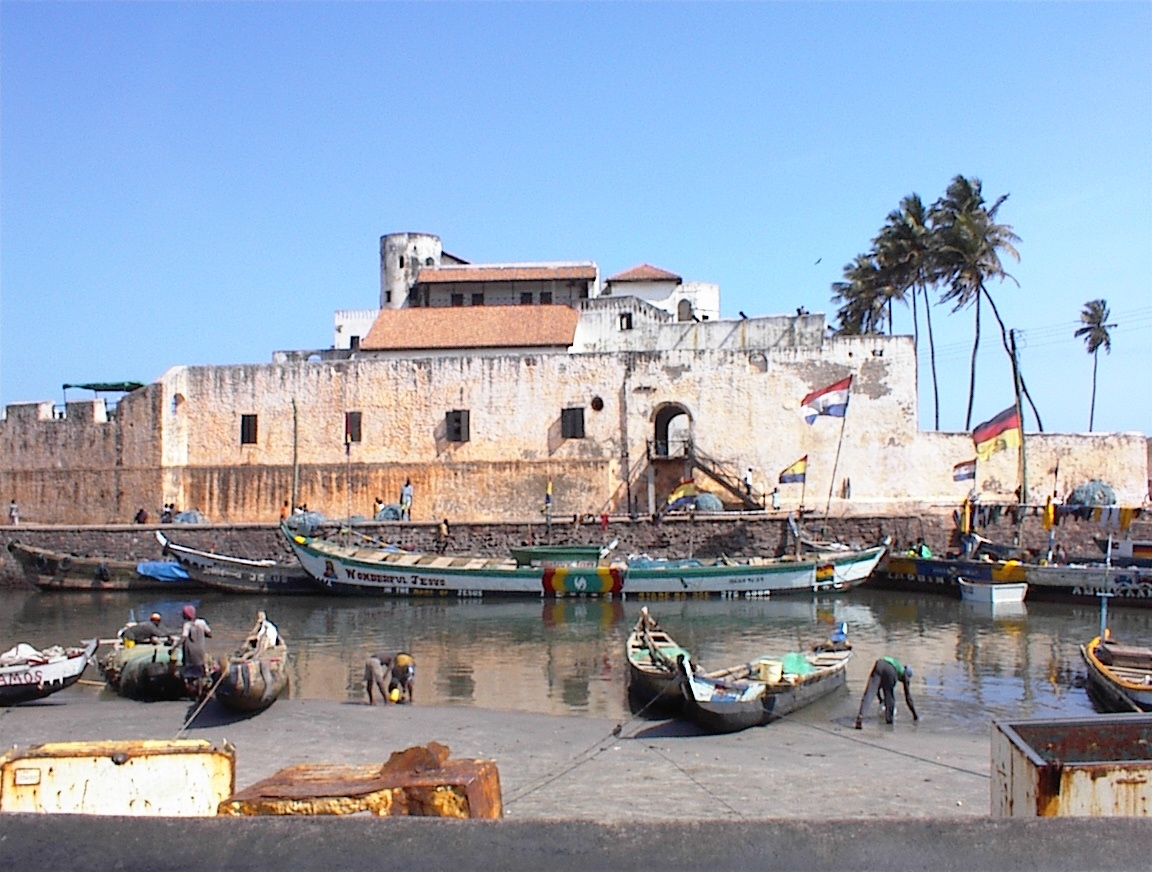
Hartman examines the African slave trade by taking a trip to Ghana. She attempts to connect with a place that is meant to be 'home'. She finds ambivalence and, in some cases, outright anger at her presence. At her insistence of bringing up the horrors of selling people.

Elmina Castle - Portuguese slave trading post
Ghana's politics on slavery are not easy water to tread. There is a modern slave trade that continues to this day. The view is that you are selling strangers, criminals, the non-religious and is therefor not a problem. Hartman paints several scenes of people telling her that the trade was bad when white men did it. They caused the problem. Her attempts to get locals to address the nobles of Africa selling off their own is met with silence.

Both of these books attempt to address race in a new way. From a different entry point. Collins comes at it with poetry and by addressing her whiteness. And using that as a means to open up what her being that means in America. She addresses blackness by acknowledging she can only address whiteness.

Hartman attempts to come at the topic of slavery honestly. She wants to see how the African tribes were complicit in the trade. She admits that going to Ghana, standing in the old Elmina castle does nothing to fill the empty space she feels. As a white man reading her book, I felt like that is the problem of the slave trade. There is no way to fill that space.

Both of these women address race calmly, without anger or melodrama. They also do it by telling their own stories. Collins tells that of her father and that 10,000 strong lynch mob. Hartman writes herself into the narrative, allowing us to see her disappointment and struggle with the topic.

Hartman manages a delicate balance of listing those accountable while not pointing a finger at the reader. Collins is less successful, but she has less room to do so. It is not her topic to be gracious about. It is not a topic to be gracious about. It is to Hartman's credit that she has chosen to open the topic up in this way.

I am grateful for Hartman's abilities to let me, a white man, into the conversation. I feel like it comes across condescending to say, but it is true. Being honest about our feelings on race is the first step to even begin to pretend to fix the problem.

10 September 2012

Review : Telegraph Avenue

Telegraph Avenue
Author: Michael Chabon
Publisher: Harper (9/11/12)
480 pages

It says a lot that Michael Chabon's publisher, Harper, has pumped more than $250,000 into marketing his new book. Some of those marketing dollars are going to open a pop-up record store in Oakland themed after the one he writes about. A lot of the rest seems to have gone to the special e-book edition:

"an interactive map of Oakland, eight videos of Mr. Chabon, a playlist created by Mr. Chabon, an animated cover, audiobook clips performed by actor Clarke Peters from "The Wire," and a "Telegraph Avenue" theme song composed by Peter Lerman."

If that sounds like a lot of gimmick for a novel, I'm with you. Also, eight videos of Chabon!? Doing what?

The basics are thus: Archy and Nat own a long-suffering record store in Oakland. Things are made worse when a superstar football player decides to open a huge record store nearby. At the same time Archy's junky ex-Blaxploitation film star father shows up because he is trying to blackmail a city councilman. Archy's until now unknown 14-year-old son also pops up and starts a friendship/sexual relationship with Nat's son. Archy's wife, Gwen is pregnant, a mid-wife, and has a run-in with a doctor that quickly gets heated.

The plot is a seems more convoluted then it is. Chabon is clearly attempting to write a Quentin Tarantino movie. He even references the director a lot and goes to pains to describe a few scenes from Kill Bill. He's aiming for that feeling of overlapping narrative, of threads weaving a whole, it comes across more like blatant ass-kissing.

The reviews of this book have all spent a lot of time discussing how great an author Chabon is. They wax on and on about his writing ability and the beauty of his prose. They all say they have problems with the book, that it is not 'perfect' but they all also say that they give him a pass because he's just so good!

It just isn't. The writing is sloppy. His attempts at writing in a musical style are irritating. His endless music and film referenced tossed into dialogue are distracting. The 12-page sentence that makes up one chapter is not creative, it's tedious. Car doors have 'lamentable lamentations' that sound like the 'gate on a crypt filled with vengeful dead folks'.

And 'From the lowest limb of a Meyer lemon, a wind chime searched without urgency for a melody to play.' It is overwrought and trying way too hard to sound interesting. It comes across like a dad at a high school party trying to be into the Lady Gaga's and Rihanna's that the kids love so much.

This isn't even discussing the questionable racial politics he plays.

The book is centered on a black family. The husband is cheating on his pregnant wife. He does it twice. The pregnant wife is portrayed in the book in mostly angry ways, she is either shouting or grumpy the whole time. The 14-year-old is having a homosexual relationship that he refuses to acknowledge because he 'isn't gay' he just likes to fuck the white boy.

The minor black characters are; an NFL star, a deadbeat junky, a fading Blaxploitation star, and a hand full of older jazz-heads who talk a lot about Mingus and Davis.

I have no issue with a white man writing black characters, but this is a grab bag of stereotypes. I think, he was trying to play with that. I think he failed.

On page 48 of the book Gwen catches her husband talking to a woman in a restaurant. Flirting. He follows her outside and they argue. She accuses him of cheating. He lies and says he isn't. In broad daylight she shoves her hands into his pants where 'Her fingers found the heavy coil of hose'. This is what follows:

"Her fingertips were briefly snagged by a film of bodily adhesive as weak as the glue on a Post-it. She tugged her sticky fingers loose, brought them to her nose...Market stalls, smoking braziers, panniers of lentils. All the spice and stink of Ethiopia: turmeric, scorched butter, the salt of the Red Sea."

Again. I THINK he is trying to play with the tropes of racism and the language of Blaxploitation and Tarantino. I dare anyone to read that quote, realize that it is a white author talking about black people, and tell me that it works for them. This is just one example, the worst in my opinion. He goes on to describe several black characters in various spice and earthen terms. A white woman is described as smelling like 'rose perfume'. My eyes fall from my face and roll on the floor.

This is before Barak Obama shows up to offer marriage advice and call a jazz trio 'funky'. The novel is set in 2004. In Oakland. The section is from Obama's perspective. It's odd and makes zero sense. You are pulled from the story and slammed into election year 2012.

This passed a cadre of editors, PR men, lawyers, etc...and they decided to throw $250,000 behind it and tart up the ebook. I'm not saying that it was to distract us, but all the reviews mention it. And so far they all say the book is flawed but Chabon is just so damn good it doesn't matter.

Sorry. It may be an attempt at something, but it ain't good. If this works for you, I'm interested in knowing why. And I want to know in terms other than Michael Chabon once wrote a good book so this one also must be good.

24 August 2012

THIS! 8/24/12

THIS! on August 24, 2012

1) Christopher Lee's Charlemagne


2) Dinosaurs

NASA discovered small dino tracks in their literal backyard. The Christian Science Monitor discusses it here. The feet in question belonged to a nodosaur.


Which was a giant spiked armadillo apparently.

Also, someone buy this blanket for me right this second. It's not my birthday or anything important, but really, I need it.


3) Racism

I really really hate Michael Chabon's new book. Like so much so that I may decide it isn't worth finishing. I really want to write a review but it's like totes not good y'all.

There is a LONG post about this that I am working on in my head about racism, white privilege, and the place of artistic licence in all of it but...it's questionable career-wise considering I have sent a query to his agent to rep my novel...

Yes, I just wrote that and meant it. Oh the pitfalls of the industry! Life is so hard! Le sigh.


4) Kaseem Reed

Dear Democrats, more of this please. Love Michael

24 September 2011

Brave

Brave (Unniversity of Mississippi Ordered to Admit James Meredith 1962) 9/24

James Meredith’s arrived in town
Ev’rybody’s got their hats bowed down

The sun don’t shine above the ground

At lunch when he comes ‘round
The bodies get up and leave him ‘lone
Ev’rybody’s got their hats bowed down

At night they bang on the floor and hound
James Meredith with thumping sound
The sun don’t shine above the gound

He graduates and thinks he’s done
But everybody wants him on loan
Ev’rybody’s got their hats bowed down

A peace fil’d life a family home
James Meredth won a war and is done
The sun don’t shine above the ground

Oxford Town, Oxford Town
Ev’rybody’s got their hats bowed down
The sun don’t shine above the ground
Ain't a-goin' down to Oxford Town

16 October 2010

24 September 2010

Mapuche

Ladies and Gentlemen it is this website's first anniversary.

Send me something nice.

Or buy a book.


Mapuche 9/24

I don’t want to be a white man writing another guilty poem about brown men

I don’t want to be a gay man writing about anal sex on a subway

I don’t want to be an English man writing about history or the way things were

I don’t want to be a young man writing in emoticons

I don’t want to be any man writing about breasts and vaginas with teeth

I don’t want to be a son writing about fucking my mother or killing my father

I don’t want to be an educated man writing about the less educated like they are dicks

I don’t want to be a man writing about the low classes or high classes

I don’t want to be a poet man writing poetry about poetry

I don’t want to be a man trying desperately to leave the shadow of the 20th century

I don’t want to be anything to anyone

I don’t want to be a white man writing about other white men

I don’t want to be a man writing for other men writing