On the Evening Before the Inauguration of the 45th President of the United States
The cold has sat on my face - holed up
in the caves of my sinuses
I sleep - wake
sit with the cat
an endless stream of movies runs by
I feel as though I am waiting for someone to come home
I have strange sentimental thoughts about an ex-boyfriend
and almost text him
but do not - and this proves something
I fall asleep and miss the sunset - it is the night and it is cold outside
the snow from last week melts and turns into mud
I found a patch of rust on the hood of my car this morning
a pock or orange-red amid the green - it is rough to the touch
it is probably spreading - I think about ways to patch it
Are there patches
I noticed that the cat is walking stiffly - that
age is creeping in him
Age is creeping everywhere
I math - I will be 39 in 2020 - the cat will be 17
will possibly not be here - will have turned into glass
On the eve of my 40th birthday will I know where I am
There is a progression of things - I told my class today
write towards the future
because whatever you write will date the second it is done
and the future needs you in ways the present does not
A moment of folding occurs
Tonight the world will go to sleep and I will not set an alarm
at 9:30 in the morning things will occur that I will not see
paths before us will have quietly lessened - and multiplied
Showing posts with label USA. Show all posts
Showing posts with label USA. Show all posts
19 January 2017


18 December 2016
Poem-A-Day #292 : Refusal
Refusal
I hear that you don't want the flag to burn
that you believe we are divided
and our hands are hurting for lack of holding
Across the table I see your eyes
they are reflecting and moving like fish in a bowl
'darting' is a word that one would use to describe them
I must confess that I am tired of kumbaya
and have little interest in comforting anyone
this is perhaps a broken part of my soul
Your words bounce around the white space
they say things like 'politics is boring' and
'we must move beyond' and 'color isn't real'
I want to throw water in your face
slam your head into the wall until everything cracks
I want there to be blood when I am done
There is the sound of winter from the doorway
a sort of whisper death come to sit at the table
The flag will burn and your hands will grow cold
is what it seems to be saying
Again
this could be a fracture in myself
The idea that nothing is politics is a refusal
a turn from the world from ourselves
Politics is just a fancy word for feelings
which you seem deeply concerned with
I hear that you don't want the flag to burn
that you believe we are divided
and our hands are hurting for lack of holding
Across the table I see your eyes
they are reflecting and moving like fish in a bowl
'darting' is a word that one would use to describe them
I must confess that I am tired of kumbaya
and have little interest in comforting anyone
this is perhaps a broken part of my soul
Your words bounce around the white space
they say things like 'politics is boring' and
'we must move beyond' and 'color isn't real'
I want to throw water in your face
slam your head into the wall until everything cracks
I want there to be blood when I am done
There is the sound of winter from the doorway
a sort of whisper death come to sit at the table
The flag will burn and your hands will grow cold
is what it seems to be saying
Again
this could be a fracture in myself
The idea that nothing is politics is a refusal
a turn from the world from ourselves
Politics is just a fancy word for feelings
which you seem deeply concerned with
04 April 2016
Sellers : When Breath Becomes Air
 When Breath Becomes Air
Author: Paul Kalanithi
Publisher: Random House (1/12/16)
256p
This isn't about this specific man's life or death.
I know little about either, though his story has been all over various mainstream media outlets, I've actively only read the bare facts. I have little interest in stories that fall into the 'human interest' category. The kind of thing that is discussed in hushed tones on the Today show. I have little interest in these stories beyond the headline and one sentence break down.
These kinds of stories are culturally woven into us. Many people enjoy clicking on the links to stories about the person who saved the dog from the highway. The kid who was dead for a few minutes and what they saw there. The person who raised a ton of foster kids being thrown a big party.
We are drawn to tales that highlight our humanity. Our best selves. This is how we've ended up with a book published 10 months after a man's death topping the bestseller list.
It is important to note that Paul Kalanithi was neither a 'known' person nor a writer before his diagnosis with cancer. It's important because this book exists because of that diagnosis, and the marketability of it as a 'story'. The newly graduated doctor in his 30s suddenly realizing that his priorities are off that his life is actually at its end. What does he do, and by extension, what would we do.
I feel like I must defend myself from imagined readers up in arms over me trashing this dead man's book. Which, I'm not. By all accounts the book is an interesting look at being young, and educated, and expecting of a long life only to have it all thrown out the window by a diagnosis. These kinds of stories are important. They teach us something about what it means to live every day, what is important.
So no, I'm not going to trash this book.
I'm more interested in the posthumous book as a cultural trope.
We put a lot of power into 'last thoughts'. The final breath before leaving this world. Call it a religious hangover in a secular society. And yes, I know, that is debatable, but...
Why do we do this?
Is it an attempt to see the other side before we get there? Those who are very ill, who are near death, are thought to be - to quote from Tony Kushner - "at the very threshold of revelation." They can see into some space we, the healthy, cannot. Supposedly.
 There is a whole genre of books by the dying. To the point that it is a morbid cliche that a diagnosis, especially in youth, can net you a book deal if you can write about your illness in an enlightening and comforting way.
That 'if' is key.
We don't want a book about how fucked up being in your early 30s and dying is. We don't want to see you suffering, unless that suffering can somehow teach you, and by extension, us how to live better lives. We need a cliched 'happy ending' tied up in your tragedy. You, who are dying, what can you tell us about living better since you will not.
Oliver Sacks was a fascinating man. Culturally, he held this space that I would liken to Neil deGrasse Tyson or Bill Nye. He was a pop intelligence. A man who could make big ideas feel close, small, relatable. His post-death collection of essays, Gratitude, was published only months after his death in 2015. This quote sums it and my point up nicely:
“My predominant feeling is one of gratitude. I have loved and been loved. I have been given much and I have given something in return. Above all, I have been a sentient being, a thinking animal, on this beautiful planet, and that in itself has been an enormous privilege and adventure.”

A feeling we don't talk about much. At least, not in western culture.
Joan Didion has made a strange shift at the end of her career. She is now the oracle of death. And while her writing has always had the air of melancholy and reflection, it has now become full-blown sermonizing on the topic of endings.
Joan Didion has made a strange shift at the end of her career. She is now the oracle of death. And while her writing has always had the air of melancholy and reflection, it has now become full-blown sermonizing on the topic of endings.
Her duo The Year of Magical Thinking and Blue Nights are, if anything, elegies/eulogies. She has somehow survived death, though I would argue that many readers/fans/literati believe these two books to be her final books. There is an air of 'the end' about them.
Even though we all experience death, we somehow need a Joan Didion, a Oliver Sacks, a Paul Kalanithi to explain it to us.
These books become our coping mechanism.
We don't allow death into our lives, so we ask a great penance of those who can access it while still with us.
You, who are dying, tell me how to live.
Sellers is my attempt to examine what books are topping the best-seller list and why. To talk about and understand the trends in popular writing.
Sellers is my attempt to examine what books are topping the best-seller list and why. To talk about and understand the trends in popular writing.
28 January 2013
The Worst Hard Time
In 1933 at the height of the Dust Bowl the US government decided to put their faith in a man named Hugh Bennett. They invented the Soil Conservation Service (now Natural Resources Conservation Service) and made Bennett the director. His view was that man was causing massive erosion, that it was one of the main environmental problems facing the planet.
Bennett was right about erosion and the Dust Bowl. By the end of the 1930s around 75% of the topsoil in 5 states (Texas, Oklahoma, Colorado, New Mexico, and Kansas) had simply blown away. 100,000,000 acres were affected
In May of 1934 a large dust storm took soil from this area and dropped it on Chicago, New York, Boston, and Washington, D.C. Dust had to be swept from Congressional offices. 12 million pounds of soil fell on Chicago and that winter red snow fell in parts of New England.
The problem was bad enough that by 1935 the Resettlement Administration was started. The main goal of the RA was to take people from failing cities and rural areas and place them in government built 'greenbelt' communities. The idea was to 'jump start' life for those most ruined by the Depression.
There was also a media wing of the RA. Roy Stryker's Photography Project, Film Projects by Pare Lorentz and Virgil Thomson, and Sidney Robertson Cowell's folk song recordings were all funded through the RA.
Below is Lorentz' 1936 film The Plow That Broke the Plains in its entirety. It's 25 minutes, but worth your time:
Lorentz' other film The River is also worth a look. It focuses on the Mississippi River and the environmental destruction from over farming and building on its banks.
I've been reading Timothy Egan's great book The Worst Hard Time. Published in 2006, the book formed the basis for Ken Burns recent PBS documentary The Dust Bowl.
Egan's book focuses on a few families and follows them from settlement, through the wet prosperous year and then into the 1930s and the great environmental catastrophe. One of his main 'characters' is Bam White, a half Cherokee/Apache ranch hand who tries his hand at farming. He is the featured plow man in The Plow That Broke the Plains.
Bennett implemented his ideas late in the 30s. 11.3 million acres were bought by the government in an attempt to heal the broken plains. Though there is much land still barren, three national grasslands dot the area, the largest is Comanche National Grassland at 600,000 acres.
The people that do still live in the area have tapped the Ogallala Aquifer. It provides 30% of the irrigation in the entire US. 82% of the people who live in the area of the aquifer rely on it for their drinking water. 1.1 million acre-feet a day are drained. This is eight times as fast as the Ogallala refills. Current projections give the aquifer 100 years until it goes dry.
The overwhelming lesson from the film and the book and the 70 years between the two is that we have not learned a thing. We have pushed the land to the point of no return, healed a small portion of it, and then have redug, replanted, and repushed it back to the brink once again. Now we're taking the underground water with us.
Living in the southwest it is hard not to be frightened of a lack of water. Of a new Dust Bowl. Animals, families, towns died from the dust. We invented new meteorology around the giant dust blizzards. Doctors had to come up with new terms for the dust pneumonia that some estimates say killed 7000 people.
2.5 million homeless. Many of whom were prodded to buy the land in the first place by low prices and promise of 'wheat wealth'. The US government pushed this land as the last 'frontier' it pushed the wheat producers in war time to plow the land. Then the government watched as it blew across the White House lawn.
The Depression and Dust Bowl are having a bit of a resurgence. It is the economic times we live in, the environmental crisis we feel lies just over the horizon.
Read Egan's book. Watch Burns' TV show. Take a look at Dorothea Lange's RA photos. (Marisa Silver has a novel called Mary Coin coming out in March based on Lange's incredibly famous Migrant Mother).
If there is a real lesson to learn, aside from how awe-inspiring the fragility of all of this is, the lesson should be this: Be aware.
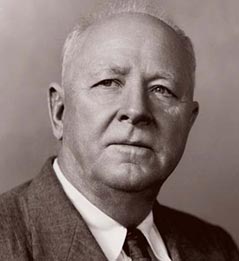 |
| Hugh Hammond Bennett |
In May of 1934 a large dust storm took soil from this area and dropped it on Chicago, New York, Boston, and Washington, D.C. Dust had to be swept from Congressional offices. 12 million pounds of soil fell on Chicago and that winter red snow fell in parts of New England.
The problem was bad enough that by 1935 the Resettlement Administration was started. The main goal of the RA was to take people from failing cities and rural areas and place them in government built 'greenbelt' communities. The idea was to 'jump start' life for those most ruined by the Depression.
There was also a media wing of the RA. Roy Stryker's Photography Project, Film Projects by Pare Lorentz and Virgil Thomson, and Sidney Robertson Cowell's folk song recordings were all funded through the RA.
Below is Lorentz' 1936 film The Plow That Broke the Plains in its entirety. It's 25 minutes, but worth your time:
Lorentz' other film The River is also worth a look. It focuses on the Mississippi River and the environmental destruction from over farming and building on its banks.
I've been reading Timothy Egan's great book The Worst Hard Time. Published in 2006, the book formed the basis for Ken Burns recent PBS documentary The Dust Bowl.
Egan's book focuses on a few families and follows them from settlement, through the wet prosperous year and then into the 1930s and the great environmental catastrophe. One of his main 'characters' is Bam White, a half Cherokee/Apache ranch hand who tries his hand at farming. He is the featured plow man in The Plow That Broke the Plains.
 |
| The Ogallala Aquifer |
The people that do still live in the area have tapped the Ogallala Aquifer. It provides 30% of the irrigation in the entire US. 82% of the people who live in the area of the aquifer rely on it for their drinking water. 1.1 million acre-feet a day are drained. This is eight times as fast as the Ogallala refills. Current projections give the aquifer 100 years until it goes dry.
The overwhelming lesson from the film and the book and the 70 years between the two is that we have not learned a thing. We have pushed the land to the point of no return, healed a small portion of it, and then have redug, replanted, and repushed it back to the brink once again. Now we're taking the underground water with us.
Living in the southwest it is hard not to be frightened of a lack of water. Of a new Dust Bowl. Animals, families, towns died from the dust. We invented new meteorology around the giant dust blizzards. Doctors had to come up with new terms for the dust pneumonia that some estimates say killed 7000 people.
 |
| Dorothea Lange, Migrant Mother 1936 |
The Depression and Dust Bowl are having a bit of a resurgence. It is the economic times we live in, the environmental crisis we feel lies just over the horizon.
Read Egan's book. Watch Burns' TV show. Take a look at Dorothea Lange's RA photos. (Marisa Silver has a novel called Mary Coin coming out in March based on Lange's incredibly famous Migrant Mother).
If there is a real lesson to learn, aside from how awe-inspiring the fragility of all of this is, the lesson should be this: Be aware.
29 September 2011
Lump
Lump (Construction of Washington National Cathedral 1907/1990) 9/29
In 83 years
Space flight etc.
In 83 years
not much occurred really
Theodore Roosevelt
laid the first stone
before 20,000 people
George H. W. Bush
watched the last finial
rise into place
Between
a few wars with little
to show for themselves
The invention
of television
24 September 2011
Brave
Brave (Unniversity of Mississippi Ordered to Admit James Meredith 1962) 9/24
James Meredith’s arrived in town
Ev’rybody’s got their hats bowed down
James Meredith’s arrived in town
Ev’rybody’s got their hats bowed down
The sun don’t shine above the ground
At lunch when he comes ‘round
The bodies get up and leave him ‘lone
Ev’rybody’s got their hats bowed down
At night they bang on the floor and hound
James Meredith with thumping sound
The sun don’t shine above the gound
He graduates and thinks he’s done
But everybody wants him on loan
Ev’rybody’s got their hats bowed down
A peace fil’d life a family home
James Meredth won a war and is done
The sun don’t shine above the ground
Oxford Town, Oxford Town
Ev’rybody’s got their hats bowed down
The sun don’t shine above the ground
Ain't a-goin' down to Oxford Town
20 September 2011
Glazed
Glazed ("Walking Purchase" of Pennsylvania 1737) 9/20
This is Edward Marshall’s shoe
This is Edward Marshall’s shoe
the leather is rotted out and crumbling
Under glass permanent forever
pulsing with the history of a great run
How far in a day and a half can man run
if it is to land grab if it is to move west
Here is Shamokin Valley
full of the displaced tribes of Pennsylvania
They are under glass
hidden beneath this stupid shoe
17 September 2011
Biocomputer
Biocomputer (US Constitution Signed 1787) 9/17
The button is buttoned
Etc…
The button is buttoned
lighted
and all the lights are on
Motors revving
16 June 2010
Desegregate
This poem was inspired by this image of Elizabeth Eckford at Arkansas Central High School in 1957:

Desegregate 6/16
In the picture she's holding her books close to her chest
her skirt is plaid they are all open teeth and snarling
snaking strands of saliva their eyes tearing themselves
from the heads
She's walking quickly in the photo but with her head up
her face is stone but you can see behind them a scream
broken wings beating her body she is a bandaged sparrow
thrashing
Are there chains on everything around her the barricades
barely do their job the police are crossed arms and hats
batons pocketed hoses out and watching the stream of
children flowing
River of stone faces rush the walk brown faces moving
through white frozen water in a fading photo but there
she is skirt in the breeze moving she is walking and she
holds her books close

Desegregate 6/16
In the picture she's holding her books close to her chest
her skirt is plaid they are all open teeth and snarling
snaking strands of saliva their eyes tearing themselves
from the heads
She's walking quickly in the photo but with her head up
her face is stone but you can see behind them a scream
broken wings beating her body she is a bandaged sparrow
thrashing
Are there chains on everything around her the barricades
barely do their job the police are crossed arms and hats
batons pocketed hoses out and watching the stream of
children flowing
River of stone faces rush the walk brown faces moving
through white frozen water in a fading photo but there
she is skirt in the breeze moving she is walking and she
holds her books close
Subscribe to:
Posts (Atom)