Let the record show that we were at least genuine - in some things - that the field of ourselves was sewn with attempts towards beauty
at times it was fallow and covered in snow - and in those times the seeds could relax - they could - wheat rests in ice to grow for early summer - can this not also be true of ourselves
I know the arguments for and against - the sighting of the hawk fighting the raven over the rabbit - there is a wheel that we are tied to
it perpetually takes us under water - rocks us against the spokes - winnows us - separates bone from meat
Field metaphors are about growth and death and cycles - they crop up like weeds in the words of great and lesser poets - they are reserves of water sitting beneath the earth - waiting like oil to be drilled from their ancient tombs
what a beautiful nostalgia - the wide-brimmed farmer aloft his perpetually churning machine - no sign of drought or of hail or early frost here
The lie in that America is obvious to any reader of any book on any subject - even not farming - but the hope in the bread belt - the grains of it a sort of pebble across the water of culture - that is nice to look at to hold to the light and to see ourselves in
does that negate ourselves - make the want of truthiness to be invalid - it at least makes our claims pyrite though no less amazing in their reality
Behind the old barn
with the peeling boards
and the holes in the roof
there is a black hole
it's small and doesn't eat much
couldn't even
in the mornings it spins itself up
and begins the slow pull
of the land
the fallow fields like a sheet over a body
pulled towards the end of the table
the old car that stopped working
the tools and the cattle that don't milk
it eats these things slowly
so that they feel their end
they know it
and it is watched
as if it were happening elsewhere
the blood not boiling
as if the sky weren't about to crack
Think about sand and how it gets in to everything it is near : kudzu does this : there are weed trees like Chinese Elm that rip open the world beneath the ground and tear up the stones of our walkways : there was tree in my backyard it was an apricot tree it tore open the sewer pipes and my backyard erupted in a monsoon of shit :
This is why we make wood into furniture : we need to tame it to control it to have it not be so wild : you could argue that humanity does that to everything : but we don't turn most things into something we put our asses on : nature is scary it is the only thing that could destroy us completely :
So we geometry out of it : pull it from the earth and turn it into grids and plots and eventually we cultivate it into things we want more than what it was : we table it until such a time as we forget it needed to be tabled :
I don't know what started the fire last night : there was a fire last night : the swarm of things that make up a building began to unravel and pull apart : a vine suddenly releasing its holds and falling from the wall into a heap at your feet :
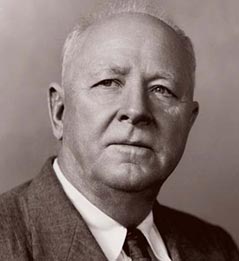
In 1933 at the height of the Dust Bowl the US government decided to put their faith in a man named Hugh Bennett. They invented the Soil Conservation Service (now Natural Resources Conservation Service) and made Bennett the director. His view was that man was causing massive erosion, that it was one of the main environmental problems facing the planet.
Hugh Hammond Bennett
Bennett was right about erosion and the Dust Bowl. By the end of the 1930s around 75% of the topsoil in 5 states (Texas, Oklahoma, Colorado, New Mexico, and Kansas) had simply blown away. 100,000,000 acres were affected
In May of 1934 a large dust storm took soil from this area and dropped it on Chicago, New York, Boston, and Washington, D.C. Dust had to be swept from Congressional offices. 12 million pounds of soil fell on Chicago and that winter red snow fell in parts of New England.
The problem was bad enough that by 1935 the Resettlement Administration was started. The main goal of the RA was to take people from failing cities and rural areas and place them in government built 'greenbelt' communities. The idea was to 'jump start' life for those most ruined by the Depression.
Lorentz' other film The River is also worth a look. It focuses on the Mississippi River and the environmental destruction from over farming and building on its banks.
I've been reading Timothy Egan's great book The Worst Hard Time. Published in 2006, the book formed the basis for Ken Burns recent PBS documentary The Dust Bowl.
Egan's book focuses on a few families and follows them from settlement, through the wet prosperous year and then into the 1930s and the great environmental catastrophe. One of his main 'characters' is Bam White, a half Cherokee/Apache ranch hand who tries his hand at farming. He is the featured plow man in The Plow That Broke the Plains.
The Ogallala Aquifer
Bennett implemented his ideas late in the 30s. 11.3 million acres were bought by the government in an attempt to heal the broken plains. Though there is much land still barren, three national grasslands dot the area, the largest is Comanche National Grassland at 600,000 acres.
The people that do still live in the area have tapped the Ogallala Aquifer. It provides 30% of the irrigation in the entire US. 82% of the people who live in the area of the aquifer rely on it for their drinking water. 1.1 million acre-feet a day are drained. This is eight times as fast as the Ogallala refills. Current projections give the aquifer 100 years until it goes dry.
The overwhelming lesson from the film and the book and the 70 years between the two is that we have not learned a thing. We have pushed the land to the point of no return, healed a small portion of it, and then have redug, replanted, and repushed it back to the brink once again. Now we're taking the underground water with us.
Living in the southwest it is hard not to be frightened of a lack of water. Of a new Dust Bowl. Animals, families, towns died from the dust. We invented new meteorology around the giant dust blizzards. Doctors had to come up with new terms for the dust pneumonia that some estimates say killed 7000 people.

Dorothea Lange, Migrant Mother 1936
2.5 million homeless. Many of whom were prodded to buy the land in the first place by low prices and promise of 'wheat wealth'. The US government pushed this land as the last 'frontier' it pushed the wheat producers in war time to plow the land. Then the government watched as it blew across the White House lawn.
The Depression and Dust Bowl are having a bit of a resurgence. It is the economic times we live in, the environmental crisis we feel lies just over the horizon.
Read Egan's book. Watch Burns' TV show. Take a look at Dorothea Lange's RA photos. (Marisa Silver has a novel called Mary Coin coming out in March based on Lange's incredibly famous Migrant Mother).
If there is a real lesson to learn, aside from how awe-inspiring the fragility of all of this is, the lesson should be this: Be aware.
This is a 25th Anniversary edition from McSweeney's. Brian McMullen is their head artistic director. He also oversees their new children's book division.
The book is set in Ghana. This is important as a starting point for the image on the cover. It is clearly an African textile print. Almost to a generic point.
These printed fabrics are beautiful. It is an obvious reference point when dealing with a book that has been called "one of the greatest novels ever to come out of the African continent". The cover is even more important when you consider that the book follows a large cast of characters.
From McSweeney's book flap: Bringing to life the bustling markets and bars in dizzying, lyrical prose, Laing weaves a story filled with bizarre and often melancholy characters...Their collective narratives create a portrait of a country where colonialism is dying, but democracy remains elusive.
A patchwork.
Of course McMullen chose to render the fabric in soft greens and browns. Tilted away from the viewer. Softly fading into the horizon.
Northwest Minn 9/09 - NASA Earth Observatory
It's a visual trick that makes it both cloth and farm land. A simple trick, but genius on McMullen's part.
Photos like the one above have always been mesmerizing for me. The weird perfection of our division of space. The OCDness of it. African cloth is just as oddly perfect. The little squares with their conflicting yet harmonious content.
This is the best visual metaphor for writing I have ever seen. Not just for this story, but all stories.
Dust Jacket is a sometime article about the design and art of book covers. The idea is to shine a spotlight on the work of the designer separate from the author. Literally judging a book by its cover.