Lately I've been thinking a lot about self.
This was my last year teaching. For the better part of 4 1/2 years this defined me in multiple ways. I was a teacher, but also an adjunct. I was paid little better than minimum wage. Making less than $2000 a month. I had other jobs. In the years I taught I also packaged items for online sale, made coffee, worked at a pizza place, wrote food reviews, worked at Publisher's Weekly on book reviews, and freelance edited. I still made less than $40k a year.
As a result my identity was one of not having. More importantly, of over-working only to not have.
I grew up ok. Not poor. My father was in the US Air Force. The buffer of not paying rent hides a lot of the discomfort of low wages for our military. Ultimately, I had a comfortably lower-middle class childhood. I never went hungry. We went on vacation. I had a Nintendo. My childhood identity was one of not thinking about identity and class.
I am now 37.
My adult life has sat firmly in the lower class. I only recently crossed the $30k marker. And I often think about how my identity, while not tied to income, is definitely tied to my relationship to $$$. Mostly, this comes out as a comfort in not ever having it. In spending it when I do.
This feels like a common response in the lower rungs of America in 2018. You use what you have when you have it. Because tomorrow you will have nothing.
For the time I was a teacher I spent most of my hours working at one of the various jobs I listed above. My identity shifting slightly with each. But in the background I was still a teacher. A writer. A person doing "good" work.
One year ago the school I worked at until this passed week announced its closure. It wasn't really a surprise, but it was a blow to both the city I live in and to myself personally.
I have never felt like the kind of person who would move for a job. And the idea of finding a teaching gig out of New Mexico actively made me anxious.
Without the background umbrella of "teacher", who was I. Was I ready to go back to being coffee shop employee, or waiter, or anything else.
It was a blow to my self.
The school officially closes June 1 but my job there is over May 16th when grades are due. At that moment I will no longer be a teacher.
Part of this shift has been trying to find a new job.
I spent 6 months last year applying to academic jobs across New Mexico and the country. Most were low-paying or only part time. Many of the out of state jobs were offering less than I was already making. The concept of moving across the country for $2000 a month is ridiculous. But I know people who took those offers. This breaks my heart. I decided I couldn't do this. That teaching, despite it being what I did, couldn't be this huge of a thing in my life that I would take a wage that couldn't even support me.
Shedding identities is not easy.
I spent most of 2017 in a literal haze. Auto pilot became pretty normal. As this final school year started I looked up for the first time in a long time and realized I had lost myself in the grind to feed myself.
I always told myself I was a writer first. Everything else was meant to be paychecks.
Somewhere along the way I convinced myself that it was ok to erode the identity of writer to the point where it became hard to say that in response to "what do you do".
How does one reclaim land washed away?
I suppose the answer has something to do with throwing the garbage in the water until you can build on top of it.
The more honest one, the healthier one, is that you don't reclaim it. You move. You build somewhere else. You don't repeat the mistakes you made. You don't allow the river in.
A new self will find purchase on the new rock.
Showing posts with label poverty. Show all posts
Showing posts with label poverty. Show all posts
14 May 2018


24 August 2016
Poem-A-Day #177 : It Has Taken Me A Long Time But I Am Ready
It Has Taken Me A Long Time But I Am Ready
His hands are the color of leather
This is wrong I know it is because it feels like theft
He reaches through the empty space of the window
I hand him the three dollars that I have decided I don't need today
I am cheap - smug - airing of family secrets
I have come to my own words for absolution
and perhaps this is the worst part of it
I want to tell him that I am sorry but I tell him to be safe which is the same thing as sorry
My own fears of poverty - I am poor - will probably die poor
but I have a roof and sometimes food
and since I don't have hands that look
like they are coated in coal I am obviously better
I do not tell him more
and I sit and wait to turn the car into traffic in a silence that builds behind my ears like cicadas storming in their trees
Better than - all my life I have felt the pressure
of somehow climbing a ladder that wasn't even before me
a ladder that no one told me I could even climb
They are screaming
I wanted to sound better and look better
I put on that drag and do my business every day
The cicadas want me to know this as I drive my car into traffic
they need me to hear these words as I listen to my music
and think about my day before me
It is a weight
cheap - smug - and trying not to be noticed as such
I am like this man with the dirty hands sitting on a corner by a McDonald's
I am this man sitting with a cardboard sign that says HUNGRY / PLEASE HELP
His hands are the color of leather
This is wrong I know it is because it feels like theft
He reaches through the empty space of the window
I hand him the three dollars that I have decided I don't need today
I am cheap - smug - airing of family secrets
I have come to my own words for absolution
and perhaps this is the worst part of it
I want to tell him that I am sorry but I tell him to be safe which is the same thing as sorry
My own fears of poverty - I am poor - will probably die poor
but I have a roof and sometimes food
and since I don't have hands that look
like they are coated in coal I am obviously better
I do not tell him more
and I sit and wait to turn the car into traffic in a silence that builds behind my ears like cicadas storming in their trees
Better than - all my life I have felt the pressure
of somehow climbing a ladder that wasn't even before me
a ladder that no one told me I could even climb
They are screaming
I wanted to sound better and look better
I put on that drag and do my business every day
The cicadas want me to know this as I drive my car into traffic
they need me to hear these words as I listen to my music
and think about my day before me
It is a weight
cheap - smug - and trying not to be noticed as such
I am like this man with the dirty hands sitting on a corner by a McDonald's
I am this man sitting with a cardboard sign that says HUNGRY / PLEASE HELP
28 January 2013
The Worst Hard Time
In 1933 at the height of the Dust Bowl the US government decided to put their faith in a man named Hugh Bennett. They invented the Soil Conservation Service (now Natural Resources Conservation Service) and made Bennett the director. His view was that man was causing massive erosion, that it was one of the main environmental problems facing the planet.
Bennett was right about erosion and the Dust Bowl. By the end of the 1930s around 75% of the topsoil in 5 states (Texas, Oklahoma, Colorado, New Mexico, and Kansas) had simply blown away. 100,000,000 acres were affected
In May of 1934 a large dust storm took soil from this area and dropped it on Chicago, New York, Boston, and Washington, D.C. Dust had to be swept from Congressional offices. 12 million pounds of soil fell on Chicago and that winter red snow fell in parts of New England.
The problem was bad enough that by 1935 the Resettlement Administration was started. The main goal of the RA was to take people from failing cities and rural areas and place them in government built 'greenbelt' communities. The idea was to 'jump start' life for those most ruined by the Depression.
There was also a media wing of the RA. Roy Stryker's Photography Project, Film Projects by Pare Lorentz and Virgil Thomson, and Sidney Robertson Cowell's folk song recordings were all funded through the RA.
Below is Lorentz' 1936 film The Plow That Broke the Plains in its entirety. It's 25 minutes, but worth your time:
Lorentz' other film The River is also worth a look. It focuses on the Mississippi River and the environmental destruction from over farming and building on its banks.
I've been reading Timothy Egan's great book The Worst Hard Time. Published in 2006, the book formed the basis for Ken Burns recent PBS documentary The Dust Bowl.
Egan's book focuses on a few families and follows them from settlement, through the wet prosperous year and then into the 1930s and the great environmental catastrophe. One of his main 'characters' is Bam White, a half Cherokee/Apache ranch hand who tries his hand at farming. He is the featured plow man in The Plow That Broke the Plains.
Bennett implemented his ideas late in the 30s. 11.3 million acres were bought by the government in an attempt to heal the broken plains. Though there is much land still barren, three national grasslands dot the area, the largest is Comanche National Grassland at 600,000 acres.
The people that do still live in the area have tapped the Ogallala Aquifer. It provides 30% of the irrigation in the entire US. 82% of the people who live in the area of the aquifer rely on it for their drinking water. 1.1 million acre-feet a day are drained. This is eight times as fast as the Ogallala refills. Current projections give the aquifer 100 years until it goes dry.
The overwhelming lesson from the film and the book and the 70 years between the two is that we have not learned a thing. We have pushed the land to the point of no return, healed a small portion of it, and then have redug, replanted, and repushed it back to the brink once again. Now we're taking the underground water with us.
Living in the southwest it is hard not to be frightened of a lack of water. Of a new Dust Bowl. Animals, families, towns died from the dust. We invented new meteorology around the giant dust blizzards. Doctors had to come up with new terms for the dust pneumonia that some estimates say killed 7000 people.
2.5 million homeless. Many of whom were prodded to buy the land in the first place by low prices and promise of 'wheat wealth'. The US government pushed this land as the last 'frontier' it pushed the wheat producers in war time to plow the land. Then the government watched as it blew across the White House lawn.
The Depression and Dust Bowl are having a bit of a resurgence. It is the economic times we live in, the environmental crisis we feel lies just over the horizon.
Read Egan's book. Watch Burns' TV show. Take a look at Dorothea Lange's RA photos. (Marisa Silver has a novel called Mary Coin coming out in March based on Lange's incredibly famous Migrant Mother).
If there is a real lesson to learn, aside from how awe-inspiring the fragility of all of this is, the lesson should be this: Be aware.
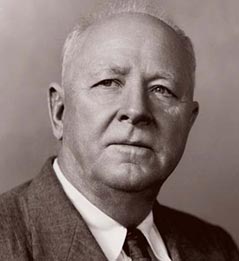 |
| Hugh Hammond Bennett |
In May of 1934 a large dust storm took soil from this area and dropped it on Chicago, New York, Boston, and Washington, D.C. Dust had to be swept from Congressional offices. 12 million pounds of soil fell on Chicago and that winter red snow fell in parts of New England.
The problem was bad enough that by 1935 the Resettlement Administration was started. The main goal of the RA was to take people from failing cities and rural areas and place them in government built 'greenbelt' communities. The idea was to 'jump start' life for those most ruined by the Depression.
There was also a media wing of the RA. Roy Stryker's Photography Project, Film Projects by Pare Lorentz and Virgil Thomson, and Sidney Robertson Cowell's folk song recordings were all funded through the RA.
Below is Lorentz' 1936 film The Plow That Broke the Plains in its entirety. It's 25 minutes, but worth your time:
Lorentz' other film The River is also worth a look. It focuses on the Mississippi River and the environmental destruction from over farming and building on its banks.
I've been reading Timothy Egan's great book The Worst Hard Time. Published in 2006, the book formed the basis for Ken Burns recent PBS documentary The Dust Bowl.
Egan's book focuses on a few families and follows them from settlement, through the wet prosperous year and then into the 1930s and the great environmental catastrophe. One of his main 'characters' is Bam White, a half Cherokee/Apache ranch hand who tries his hand at farming. He is the featured plow man in The Plow That Broke the Plains.
 |
| The Ogallala Aquifer |
The people that do still live in the area have tapped the Ogallala Aquifer. It provides 30% of the irrigation in the entire US. 82% of the people who live in the area of the aquifer rely on it for their drinking water. 1.1 million acre-feet a day are drained. This is eight times as fast as the Ogallala refills. Current projections give the aquifer 100 years until it goes dry.
The overwhelming lesson from the film and the book and the 70 years between the two is that we have not learned a thing. We have pushed the land to the point of no return, healed a small portion of it, and then have redug, replanted, and repushed it back to the brink once again. Now we're taking the underground water with us.
Living in the southwest it is hard not to be frightened of a lack of water. Of a new Dust Bowl. Animals, families, towns died from the dust. We invented new meteorology around the giant dust blizzards. Doctors had to come up with new terms for the dust pneumonia that some estimates say killed 7000 people.
 |
| Dorothea Lange, Migrant Mother 1936 |
The Depression and Dust Bowl are having a bit of a resurgence. It is the economic times we live in, the environmental crisis we feel lies just over the horizon.
Read Egan's book. Watch Burns' TV show. Take a look at Dorothea Lange's RA photos. (Marisa Silver has a novel called Mary Coin coming out in March based on Lange's incredibly famous Migrant Mother).
If there is a real lesson to learn, aside from how awe-inspiring the fragility of all of this is, the lesson should be this: Be aware.
Subscribe to:
Posts (Atom)