30 September 2013

Dust Jacket : Every Day

Every Day
Jacket art by: Adam Abernathy

I love me some black and white photography. Even more so if the tone of the print is icy cold.

The cover to this really great young adult novel takes those loves and adds another - off-white paper.

In these covers posts I don't usually read the book I'm talking about. It's meant to be about the design only.

BUT. Read this book.

David Levithan is a great author. Every Day is about a person who wakes up a different teenager each day. Different sex, different race, different everything. The main character falls in love and must overcome the weirdness of the relationship. It manages to be a perfect metaphor for general teen angst, transgender issues, gay issues, etc. So so so so good. Read now.

Now that I got my infomercial out of the way.

This cover immediately reminds me of:

Garnet Lake (2010) - Peter Essick
And:
 Person Floating - Jens Sage
The sense of wonder in it. Of drifting. It is beautiful.

Outside of the photo work, the use of a window motif makes the whole thing feel like we, the reader holding the book, are watching this scene from inside our own home. Do we open the window or not?

It's a nice visual nod to the role of reader and author. That promise that something awesome may lie inside. If you open the cover.


Dust Jacket is a sometime article about the design and art of book covers. The idea is to shine a spotlight on the work of the designer separate from the author. Literally judging a book by its cover.

02 September 2013

Hadrian the Seventh

The official List of Popes spans 21 centuries of human history. It begins with St. Peter and ends, obviously, with Francis. In between are 266 men. A few highlights:

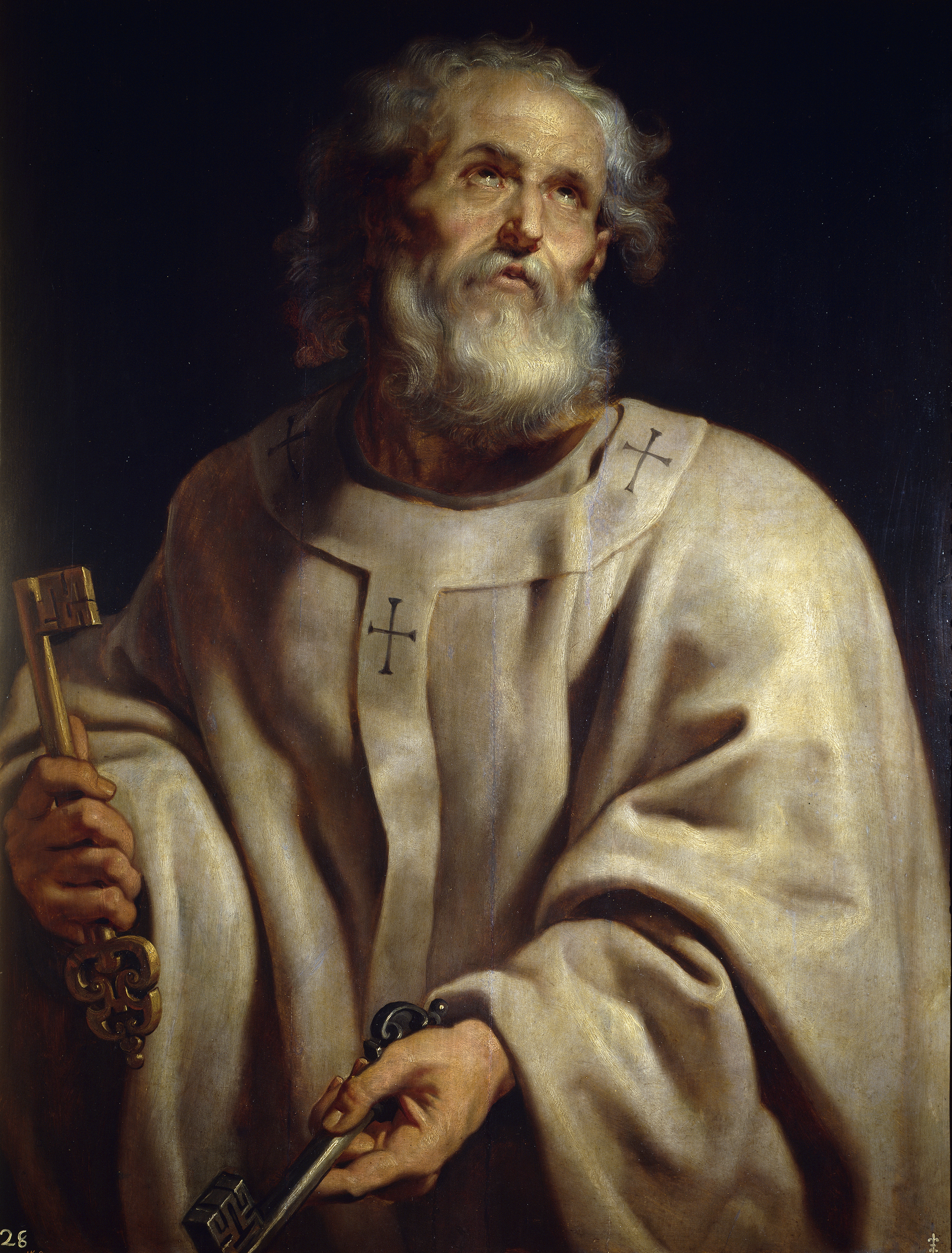
St. Peter by Peter Paul Rubens
- From August 1799 - March 1800 there was no Pope. The previous, Pius VI, died in France while imprisoned by Napoleon. There have been 4 other breaks between Popes. Those were for 2 or 3 years and were mainly caused by politics in the church.

Pope-elect Stephen died 3 days after being elected and before his ordination. The Catholic church removed him from the official list of Popes in 1961. Though Stephen's after him counted him in the number after their names.

Benedict IX was Pope 3 times. He was deposed all twice and sold the Papacy to Gregory VI because he wanted to marry. What's amazing is that he became Pope the third time AFTER he sold the seat.

John Paul II has the third longest reign behind Pius IX and St. Peter. He was Pope for 26 years. Pius IX for almost 32. St. Peter is said to have reigned for 34 years.

Study after Velázquez's Portrait of Pope Innocent X 1953
This is just scratching the surface. This leaves out the Borgia Popes and the 41 Anti-Popes. And when Pius IX declared himself Prisoner of the Vatican in 1870 and the title stuck until 1929. And countless other things.

My favorite Pope-related artifact is the series of Pope Innocent X paintings by Francis Bacon. In all, there are 45 variations. Bacon was painting after the famous Velázquez painting of Innocent X.

I've always loved the horror in the paintings. The feeling of a caged soul. A trapped thing. That yawning mouth eating the world.

It is critique without being critique. Bacon famously said that he painted the Pope because he merely sought "an excuse to use these colours, and you can't give ordinary clothes that purple colour without getting into a sort of false fauve manner."

I bring up Popes because I just finished reading Hadrian the Seventh by Frederick Rolfe. The book concerns George Rose, an Englishman who is basically elected Pope on accident after Leo XIII dies in 1903. What follows is one year in the life of the new Pope. He sells off the Vatican jewels and forces Europe to redefine its borders. And then he is assassinated by socialists.

Fr. Rolfe
The book is an interesting look at church politics. There are pages of Papal machinations and in-fighting. There is a scene where Hadrian removes his Papal ring and confronts his Cardinals not as Pope but as George Rose that is one of the most interesting exchanges I've read recently. The compartmentalization that Hadrian/Rose puts himself through to allow himself to BE Pope is amazing.

Frederick Rolfe's book is also mostly a thinly coated wish. He was a failed Catholic priest. He shortened his name to Fr. so people would think he was a friar. The book reads like one long fever dream of a man who felt that the world owed him more. And for that alone, you should go read it. Each page is a screed on what Rolfe thinks the church should be doing vs. what they are doing.

I could discuss Rolfe's at length, but will just add that he dabbled in photography. Of young boys. He was an open homosexual in Victorian England. He died alone and penniless in Venice at the age of 53. And he carried on a long distance affair through love-letters and poems with a priest.

19 August 2013

The Only Thing I Have To Declare Is...

Last night I went to the opera. The show was the new opera 'Oscar' that had its premier at the Santa Fe Opera this summer. It moves to Philadelphia in 2015.

It is a good thing that the show has over a year before its next performance because it was not good. The worst I've ever seen.

It managed to be outdated, dull, poorly directed, drama free, and generally awful. How does a new show feel like it's 30 years old?

It was witless. Artless. My jaw dropped and I held my sweater in front of my mouth so bugs wouldn't fly in there.

It was not about overcoming adversity. It wasn't about love. It wasn't about politics. It wasn't about Oscar Wilde. I don't even know what it was about because it was so so so broken.

The lyrics were laughable. The prison was played for comedy then discussed as a hellish place. It was all telling and zero showing. Walt Whitman was the narrator? Bosie was a mute dancer......

I have no real words to describe it beyond this. Because it was that bad. There was a song about ABSINTHE.

When I see bad art I have to think it out. I joked last night that I would need to go to therapy to process the night. It was a joke, but kinda true. Bad art is depressing, sad, etc. But gigantic failures have lessons hidden in them. Lessons about process and editing. Lessons about huge corporations pumping money into the creative process. Lessons about people not telling other people no.

It makes me want to scream. Scream then write a better version.

As we were clapping for the cast at the end you could feel the sadness in the room. A sort of 'sorry guys' vibe. I clapped for the fact that the cast was trying their best. The score was interesting. The set was really good.

But every time the show would get to something good it would do something absolutely mind-numbingly dumb. Like end with Walt Whitman ushering Oscar Wilde into heaven...where a pantheon of classic writers dressed in white angel costumes welcome him into 'immortality'. And his response? He makes a joke about wanting to make a good sauce and says 'thanks'...

I don't even know what more to say right now. That is how weird the experience was. It is hard to be coherent about incoherence. Hard to form a center about a non-held object.

Will someone in Philadelphia go see this hot mess in 2015 and tell me if it is good? Better yet, someone let me stay with them so I can watch it again and see what's different. Because it will ALL be different.

02 August 2013

Sunflowers

I've been a little over stimulated on the internet and writing fronts lately.

Blame this on summer. On the jungle of sunflowers outside my house. On the intense storms that rush in off the mountains every evening.

Blame it on me suddenly having several writing gigs to juggle outside of the blogs I am meant to be keeping for personal 'satisfaction' and artistic 'growth'.

You can blame it on summer lazies.

But in reality I have reached a saturation point with 'social' media. There have been too many things to be too angry and concerned about and too many incredibly obnoxious and illogical and fucking stupid voices screaming at the top of their lungs for the last month or so.

And I have sort of been broken by it.

I've started tweeting short non sequiturs and one word answers. I've been posting videos of my cat staring at me on Facebook.

I've been reading about turtles. And the strange, creepy YouTube channel - Pronunciation Book.

The point is that I'm still here. That I am writing and working and it's just not making its way to this blog at the moment. But it will.

In the meantime. Check out Coldfront, I write there sometimes. And starting next month I will be featuring some book reviews of new McSweeney's titles right here.

29 July 2013

Transit

The first American forces arrived in Europe in January. In March the War Relocation Authority was signed into law by Roosevelt creating internment camps for Japanese citizens. Anne Frank started her famous diary in June. In December the first self-sustained nuclear chain reaction is set off under the bleachers on the football field at the University of Chicago.

And Anna Seghers wrote Transit, a book about the plight of refugees of the Nazis. The book would be published in 1944.

The book basically details the bureaucratic process of getting transit papers. Those papers are defined as: "A transit visa...gives you permission to travel through a country with the stipulation that you don't plan to stay." And that is the entire plot. A man who just wants to stay but cannot. Anywhere.

Seghers went through this process. She fled to Marseilles in 1940 and then on to Mexico in 1941. She wrote The Seventh Cross there and it was released in 1942. It was one of the earliest representations of a concentration camp in media. A movie version was made in 1944. It starred Spencer Tracy, Hume Cronyn and Jessica Tandy.

It's hard to imagine in 2013 the idea of fleeing your home and then moving consulate to consulate hoping to find a country to take you away to a better life. Or maybe it isn't. The Edward Snowden/NSA story seems out of spy novels. Out of WWII era tales of people trapped, country-less. Whether or not you agree with the details, the similarities are interesting.

That the ultimate feeling from the book is one of hopelessness. A sense of futility. It becomes clear that Seghers is very suspicious of people who leave Europe. In the end her main character decides to attempt to stay. To carve out a new life for himself. He chooses to not abandon Europe. And it is shown to be noble.

It is a bold statement in 1942 to make.

It is a bold thing to openly talk about the horrors of WWII.

I was reminded of Carlie Chaplin's The Great Dictator. That film holds a firm place in history as an early shout against the Nazi takeover of Europe. The final speech is still shocking and wonderful to hear today. And this book seems to conjure a darker version of it.


From the afterword by Heinrich Boll:
For anyone who would like to make writers aware of the dangerous conditions under which they live and write, I would refer them to the last danger enumerated by Saint Paul and cited by Anna Seghers: 'Perils among false brethren'.

The cover of the new NYRB edition has a cover featuring a drawing by Francis Picabia.

15 July 2013

Foundational

Edmund Dulac
I said something deep today while talking on the phone with JAA. The discussion was about ourselves as writers. A notoriously douchey conversation topic, but we are writers so we talk about that thing a bunch.

We had stumbled into a discussion of looking backwards at our old work. Seeing what it was about. Learning from it. Personal archeology. JAA writes in journals all the time. Every few months he takes a journal and moves the work onto a computer and begins to edit. I tend to not write things down. It means I forget a bunch, but the written word is like concrete to me and I don't like to set things too early.

I mentioned that I do have a pretty rigorous computer filing system. It's by year and alphabetical. I even put draft numbers in there.

I mentioned that I was sifting through poems from 2000 recently. That it felt like a gift to be able to go back to that time and rethink the work. Edit it. And here's where I got all deepish. I said:

As writers, we get to rewrite our pasts. Erase it. Rework it until it's perfect.

And thinking on that, I realize that I meant it. But not in a erasing the past to pretend it didn't happen way. In a way similar to a cover-up tattoo. You will always remember that there was something else there, Always. And maybe only you can see it. But it exists. Foundational. Underneath.

I've been thinking a lot about foundation lately. Being back in NM has led me down paths I walked 12 years ago. My early 20s were spent writing a lot and working only on weekends. It was great in the way only your college years can be.

My foundation as a writer is in that space. That work. Re-reading it, I am struck by how of that space I was. Writing angry anti-war poems. Aping Ginsberg's voice. Trying to write a poem about body image form a woman's perspective. A few slightly questionable sex poems that border on being rapey. It's all very young man of me. Very Bush V. Gore of me.

At the same time I've been reading a few actual foundational texts for my Pub Weekly review gig. I read a new translation of One Thousand and One Nights by Hanan-al-Shaykh. And then this week I did the new Wole Soyinka translation of Forest of a Thousand Daemons by D. O. Fagunwa. The Fagunwa book is only from 1939 but is deeply foundational to modern African lit. 1001 Nights is obviously foundational to most lit.

They relate to each other in tone, in topics, and in structure. They both are about someone telling stories. They both rely heavily on morality and on a readers pre-known knowledge of certain tropes. They 'teach'. And they both have deep, problematic sex politics.

Foundational literature - Aesop. Plato. 1001 Nights. Forest of a Thousand Daemons - is a thing we often don't think about. That little hidden thought in the back of our head. It only rears up when we actually reopen the file saved away somewhere. When we stare into it long enough to see ourselves in there.

The ugly and the beautiful.

08 July 2013

The Crisis of the European Mind

Paul Hazard on poetry at the hands of Realists in the late 1600s:

"To the rich music, the soothing caress that may be born of words, they were wholly insensitive, and all sense of mystery had vanished from their souls. They floodlit the world with the pitiless glare of realism...

...If poetry is prayer, they never prayed; if it is reaching out towards the ineffable, they would not hear of the ineffable; if it is to hesitate on the delicate line betwixt music and meaning; they never hesitated; no, not they! They aimed at being just so many proofs and theorems. When they did write verse, it was merely a vehicle for their ideas on geometry."

2013 NYRB edition
The part that sticks out to me most are the lines about prayer and the ineffable. Poetry as a prayer to self, a personal god, the world, humanity. It rings with a kind of truth that I find hard to argue with.

This comes very near the end of Hazard's classic take down/history of the Enlightenment, The European Mind 1680-1715. The book is dense and catty. My knowledge of the Realists is not strong enough to agree or disagree with the thesis - That the Enlightenment may have put arts such as poetry on a back burner in favor of hard, cold reality.

I do think you could argue that while not poetry in its strictest sense, Voltaire, Locke, Spinoza, et al do reach a sort of poetic space by virtue of their ability with language. But it requires a very broad definition of poetry.

Here is Rousseau from Discourse on Inequality:

The first man who, having fenced in a piece of land, said "This is mine," and found people naive enough to believe him, that man was the true founder of civil society. From how many crimes, wars, and murders, from how many horrors and misfortunes might not any one have saved mankind, by pulling up the stakes, or filling up the ditch, and crying to his fellows: Beware of listening to this impostor; you are undone if you once forget that the fruits of the earth belong to us all, and the earth itself to nobody.

I put the parts I find most poetic in bold. This might help you see what I mean more clearly:

The first man,
having fenced
a piece of land said,
This is mine

How many horrors
might one have saved
by pulling the stakes,
filling the ditch,
and crying out:

Beware this impostor;
you are undone to forget
the earth belongs
to nobody.

Nicolas-Charles-Joseph Trublet said in 1735:

"The earliest writers, we are told, were poets. That I can well believe; they could not very well have been anything else. But the latest will be philosophers."

I would argue there isn't a difference.