What was the thought process - the former Queen walking to her death with a terrier in her petticoats - was the dog so normal against her legs that she didn't think to leave him - and how did it get by the guards the man with the axe the crowd beyond the scaffold -
And after - when the dog wrapped itself in her dress and refused - and became bathed in her blood - the royality of that baptism - a terrier saturated until the color of her sleeves - after - was the dog able to stare into the faces of politicians and not flinch -
They burned everything that her blood touched - the block her head rested on - the gold-embroidered mask across her had to be hacked off twice head - the dress and the wood of the platform - all in the fireplace until ashes were all that remained -
And it makes one ask about the dog - they supposedly washed it - they supposedly kept hold of its trembling loneliness - one can assume - until it died from the chill of living outside the coats of a Queen
There are so many words about this - and adding to that pile is useless
I remember reaching the rose out towards you as you walked
the line - it was peach and you took it and smiled into my face
Someone behind you would collect all the hundreds of flowers
and place them into a car
a whole car for flowers
I think about the driver - the person in the suit and hat driving flowers
through the streets of Banbury - passed the cross
naked and ringing in the light of all those faces
This was probably 91 and you were so loved and so shining and perfection
unattainable was yours - the woman getting it all
and then some
It was before revelation - before you sat alone on the bench in India
the shock of your red and purple - the so very alone-ness of it
the breaking down of the metaphor - accident - and not
The first wife - in the tomb - alone and objectified - glowing forth
how prophetic and strange
that life can be both oracle and stasis field
Piles of static collect around this tomb and your own - they mulch
I think about my childhood - and I have nothing
to further the sound of my voice
I don't have comparison - there is no doorway to open here
just the hanging moment of child arm and hand reaching
out - a long stem covered in thorns - pointed like a question
The answer in that car - that will forever be driving away - forever
smelling of too many flowers
And since the elections, it sometimes seems we are the only (Thatcher Erased) - from a speech delivered by Margaret Thatcher in 1987
6. Our PoliciesConclusion
Our policies, Conservative policies, are bearing fruit and we have every reason to be pleased. But we must not let satisfaction turn to euphoria.
We are ready for improved relations with the Soviet Union. But we can't afford to take anything on trust. Nor should we be deceived by changes in style rather than substance. We shall continue to judge the Soviet Union not by what they say but by what they do.
We believe that the strategic nuclear weapons of the United States and the Soviet Union could be reduced by 50 per cent without endangering western security. But so long as the Soviet Union continues to enjoy massive superiority in chemical and conventional forces, we say that reductions in nuclear weapons in Europe have gone far enough. As the Supreme Allied Commander in Europe reminded us recently: it is not a nuclear-free Europe we want, it is a war-free Europe. Nuclear weapons will continue to play a vital role in preventing war in Europe—as they have done for forty years. And that is why we will press ahead with Trident and the modernisation of our independent deterrent, vital to our security. Mr President, the British people want peace. But it must be a peace with freedom and justice. And that peace is only maintained by keeping our defences strong, by resisting violence and intimidation at home, and by standing up to tyrants and terrorists abroad.
That is the true spirit of the British people. That is the spirit which sustained us through two world wars. And it guides us still. CONCLUSION Mr President, you may perhaps have heard that I'm a faithful student of Rudyard Kipling.
Occasionally, I've even been known to quote him. So it won't come as a complete surprise if I refer to his poem "Recessional", in which he warned us to beware of boasting and to keep "A humble and a contrite heart". That's sound advice to any Government. But may I say today we have both a right and a duty to remind the whole free world that, once more, Britain is confident, strong, trusted. Confident, because attitudes have changed. "Can't be done" has given way to "What's to stop us?" Strong, because our economy is enterprising, competitive and expanding. And trusted, because we are known to be a powerful ally and a faithful friend. All this has been made possible by the national revival which we have carried through. And everyone in this hall, and millions outside it, can claim a share in that revival.
Now, once again, it has fallen to the Conservatives to lead the nation into the 1990s. Let us face that future with quiet confidence born of what we have accomplished in the last eight years.Britain's institutions are shaped by the character of her people. It's all that is gifted, just and fair in that character which reassures our friends and allies; and brings hope to those who have yet to know the liberty we take for granted. Mr President, it is a great trust which has been placed in our care. May we never fail that trust.
And since the elections, it sometimes seems we are the only (Thatcher Erased) - from a speech delivered by Margaret Thatcher in 1987
5. Defense
Mr President, our conference takes place at a time which could prove to be a historic turning point in world affairs. And we can say—with some pride—that Britain has played a major part in creating the opportunities which now open up before us. It is, of course, a time of tension and even of danger in the Persian Gulf. But there, too, Britain is giving a strong lead. And I do indeed pay tribute to both Geoffrey Howe and you, Mr President, for the lead which you have given. May I join you, Mr President, in speaking for this whole conference—and indeed for the people of this country—when I express our thanks and appreciation to the Merchant Officers and seamen who sail that vital waterway; and to the Royal Navy's Armilla Patrol and its minesweepers which protect them. We honour their dedication and their courage.
But today is also a time of hope. Indeed there is no mistaking the bracing air of change in the Soviet Union. In my many hours of talking with Mr Gorbachev in Moscow earlier this year, his determination to bring about far-reaching reform was plain. The difficulties and obstacles confronting him are massive. But we must recognise that anything which increases human liberty, which extends the boundaries of discussion and which increases initiative and enterprise in the Soviet Union, is of fundamental importance in terms of human rights. And that's why we support it. That is why we have publicly welcomed and encouraged those aspects of Mr Gorbachev's reforms which do just this. They are genuinely courageous—not least in their admission that, after seventy years, the socialist system has failed to produce the standard of life the Russian people want. But Mr President, we have yet to see that change carried through into the Soviet Union's policies towards the outside world. The traditional instruments of Soviet power—military strength, subversion, propaganda—are all being exercised as vigorously as ever. Afghanistan is still occupied. The Berlin Wall still stands, and Soviet weapons are still pouring into Third World countries which need food but not arms. They get the food from the free world and arms from the Soviet Union.
There is however hope in the agreement which now seems certain to be signed later this autumn, by the United States and the Soviet Union, to eliminate medium and shorter-range nuclear missiles. We welcome that agreement. Indeed Britain has contributed in a major way to its achievement. It's a success for the West—especially for the United States and President Reagan. But let us remember one thing. If we had listened to the Labour Party and to CND—insofar as you can distinguish between the two—that agreement would never have been achieved. The Russians would have kept their thirteen hundred nuclear warheads, while the West would have given away its three hundred, for nothing in return. That lesson must never be forgotten. Reductions in nuclear weapons come about not from weakness, but from strength.
And since the elections, it sometimes seems we are the only (Thatcher Erased) - from a speech delivered by Margaret Thatcher in 1987
4. The Fight Against Crime
But our greatest concern, in inner cities and elsewhere, is to reverse the tide of crime which disfigures our lives. On Wednesday, we debated crime with a depth of concern that reflects the feelings of every decent person in the country. Crime invades homes; it breaks hearts; it drags down neighbourhoods; and it spreads fear. The Government is playing its full part in the fight against crime. We have strengthened the Police. We have introduced tougher sentences. Violent crime concerns us, above all. It's not just that violent crime is worse than other crime. It's much worse.
And that's why we are now taking still tougher action against knives and against guns. Even so the feeling persists that some of the sentences passed by the courts have not measured up to the enormity of crime.
And so as Douglas Hurd announced this week, we shall be introducing legislation to provide for an appeal against sentences which are too lenient. And may I point out it will be the second time this Government has brought a measure of this kind before Parliament. And I hope that this time it will receive a speedy passage on to the statute book. But we shall make little progress in the drive against crime if we expect the police and the courts to take on the whole burden.
When we are sick, we turn to the doctor; yet we accept responsibility for taking care of our health. When fire breaks out, we call in the Fire Brigade; yet we know it is up to us to take sensible precautions against fire. So it is with crime. There is enormous scope for the public to help the police in what, after all, is a common duty: in neighbourhood watch; in businesses watch; in crime prevention; in prompt reporting of crime seen or suspected; and in readiness to give evidence.
But even that is not enough. Civilised society doesn't just happen. It has to be sustained by standards widely accepted and upheld.
And we must draw on the moral energy of society. And we must draw on the values of family life. For the family is in the first place where we learn those habits of mutual love, tolerance and service on which every healthy nation depends for its survival.
It was Sir William Haley, the great Editor of The Times, who, twenty years ago, said this, "There are things which are bad and false and ugly and no amount of argument or specious casuistry will make them good or true or beautiful. It is time that these things were said". And he said them. But if we are to succeed today, all those in authority must recover that confidence and speak with a strong, emphatic and single voice. Because too often, they speak in different and conflicting voices. The great majority of crimes are committed by young people, in their teens and early twenties. It is on such impressionable young people that anti-police propaganda and the glamorisation of crime can have the most deadly effect. And when left-wing councils and left-wing teachers criticize the police they give moral sanction to the criminally inclined. When the broadcasters flout their own standards on violent television programmes, they risk a brutalising effect on the morally unstable.
When the Labour Party refuses to support the Prevention of Terrorism Act—an Act that saves lives—they weaken society, they weaken society's resistance to the modern scourge of terrorism. Local councils, teachers, broadcasters, politicians: all of us have a responsibility to uphold the civilised values which underpin the law.
We owe it to society of which we are a part. And we owe it especially to future generations who will inherit the society that we create. (Applause)
And since the elections, it sometimes seems we are the only (Thatcher Erased) - from a speech delivered by Margaret Thatcher in 1987
3. Inner Cities
Now Mr President, the phrase "inner cities" is a kind of convenient shorthand for a host of problems. Cities have risen and declined throughout history. Risen by responding to the opportunities, the markets, the technologies of their day have offered. And declined when they clung to old, outdated ways and new markets passed them by. That is what's happened to many of our great cities. And their decline was sometimes aggravated by the worst form of post-war town planning—a sort of social vandalism, carried out with the best of intentions but the worst of results.
All too often, the planners cut the heart out of our cities. They swept aside the familiar city centres that had grown up over the centuries. They replaced them with a wedge of tower blocks and linking expressways, interspersed with token patches of grass and a few windswept piazzas, where pedestrians fear to tread.
The planners didn't think: "Are we breaking the pattern of people's lives. Are we cutting them off from their friends, their neighbours?" They didn't wonder: "Are we uprooting whole communities?" They didn't ask "Can children still play safely in the street?"
They didn't consider any of these things. Nor did they consult the police about how to design an estate in which people could walk safe from muggers and vandals. They simply set the municipal bulldozer to work. What folly, what incredible folly.
And the people who didn't fit into this urban utopia? They dispatched them to outlying estates without a pub or corner shop or anywhere to go. Oh! the schemes won a number of architectural awards. But they were a nightmare for the people. They snuffed out any spark of local enterprise. And they made people entirely dependent on the local authorities and the services they chose to provide. And as if that were not enough, some of our cities have also been dominated by Labour councils implacably hostile to enterprise. So when industries left, they piled higher rates on those that remained. When old markets vanished, they sought not new markets but new subsidies. And they capitalised not on their strengths, but on their weaknesses. And in fact they accelerated decline.
So dying industries, soulless planning, municipal socialism—these deprived the people of the most precious things in life: hope, confidence and belief in themselves. And that sapping of the spirit is at the very heart of urban decay. Mr President, to give back heart to our cities we must give back hope to the people. And it's beginning to happen.
Because today Britain has a strong and growing economy. Oh yes, recovery has come faster in some parts of the country than others. But now it is taking root in our most depressed urban landscapes. We all applaud the organisation "Business in the Community"—it is over 300 major firms that have come together to assist in reviving the urban communities from which so many of them sprang.
So many of the amenities of our towns and cities—the parks and public gardens, the libraries and art galleries, the churches and schools—they had their origin in the philanthropy of men who made good themselves, and they wanted to do good for others. That impulse—that sense of obligation to the wider community—it is that we must enlist today.
I've seen the start of recovery for myself: on Teeside, in Gateshead, in Wolverhampton and the West Midlands. And in Glasgow, which is undergoing a remarkable revival, thanks largely to the work of George Younger and Malcolm Rifkind. I shall never forget one Glaswegian I met on my visit there. "How do you do?" I said. "My name's Margaret Thatcher." "Mine's Winston Churchill", he replied. And astonishingly enough it was. And he produced a document to prove it. Winston Harry Churchill. Absolutely splendid person.
Mr President, to speed up the process of recovery in these and other places, we have a whole battery of special measures and programmes—you heard about them from Kenneth Clarke: special measures and programmes to clear derelict land—to renovate run-down council estates—and to regenerate city centres—and to turn dereliction into development. But by themselves these measures are not enough. We must also give people in the inner cities the opportunity to improve their own lives and the belief that they can do it.
The major reforms in our programme are of course designed for the whole country. But they will be of particular benefit to inner cities. We will free tenants from their dependence on council landlords. We will free parents to choose the schools they want for their children. We will free businesses in the urban development areas from irksome planning restrictions and controls.
And with our rate reform legislation, socialist councils will no longer be able to drive out small businesses and destroy employment by imposing sky-high rates. And above all, the community charge will make local councils far more accountable to all their voters.
With all these things taken together, these measures will greatly reduce the power of the local council over tenants, parents, pupils and businesses; and greatly increase the opportunities open to those very people. To coin a phrase it is an "irreversible shift ... of power ... in favour of working people and their families". Mr President, the social problems of some inner cities are deep-seated. Quick and easy solutions are not possible. But the philosophy of enterprise and opportunity, which has put the spark back into our national economy—that is the way—and the only way—to rejuvenate our cities and restore their confidence and pride.
And since the elections, it sometimes seems we are the only (Thatcher Erased) - from a speech delivered by Margaret Thatcher in 1987 2. Education
And Mr President, our most important task in this Parliament is to raise the quality of education. You heard what Kenneth Baker had to say about it in that most interesting, stimulating debate we had the other day. It's in the national interest. And it's in the individual interest of every parent and above all, of every child. We want education to be part of the answer to Britain's problems, not part of the cause.
To compete successfully in tomorrow's world—against Japan, Germany and the United States—we need well-educated, well-trained, creative young people. Because if education is backward today, national performance will be backward tomorrow.
But it's the plight of individual boys and girls which worries me most. Too often, our children don't get the education they need—the education they deserve. And in the inner cities—where youngsters must have a decent education if they are to have a better future—that opportunity is all too often snatched from them by hard left education authorities and extremist teachers.
And children who need to be able to count and multiply are learning anti-racist mathematics—whatever that may be. Children who need to be able to express themselves in clear English are being taught political slogans. Children who need to be taught to respect traditional moral values are beingtaught that they have an inalienable right to be gay.
And children who need encouragement—and children do so much need encouragement—so many children—they are being taught that our society offers them no future.
All of those children are being cheated of a sound start in life—yes cheated.
Of course—in the country as a whole—there are plenty of excellent teachers and successful schools. And in every good school, and every good teacher, is a reminder of what too many young people are denied. I believe that government must take the primary responsibility for setting standards for the education of our children. And that's why we are establishing a national curriculum for basic subjects. It is vital that children master essential skills: reading, writing, spelling, grammar, arithmetic; and that they understand basic science and technology. And for good teachers this will provide a foundation on which they can build with their own creative skill and professionalism.
But the key to raising standards is to enlist the support of parents. The Labour left—hard, soft and in-between—they hate the idea that people should be able to choose. In particular, they hate the idea that parents should be able to choose their children's education. The Conservative Party believes in parental choice. And we are now about to take two dramatic steps forward in extending choice in education. First, we will allow popular schools to take in as many children as space will permit. And this will stop local authorities from putting artificially low limits on entry to good schools.
And second, we will give parents and governors the right to take their children's school out of the hands of the local authority and into the hands of their own governing body. This will create a new kind of school funded by the State, alongside the present State schools and the independent private schools. These new schools will be independent state schools. They will bring a better education to many children because the school will be in the hands of those who care most for it and for its future.
Mr President, there's no reason at all why local authorities should have a monopoly of free education. What principle suggests that this is right? What recent experience or practice suggests it is even sensible? In these ways, we are furthering our Conservative tradition of extending opportunity more widely. This policy will be of the greatest advantage, not to those schools where the parents are already satisfied with their children's education, but to those schools where the parents are dissatisfied and believe that their children could do a lot better. Nowhere is this policy more needed than in what have come to be known as "inner cities". It will profit those people most.
And since the elections, itsometimesseems we are the only (Thatcher Erased)
- from a speech delivered by Margaret Thatcher in 1987
1. From Impossibility to Victory
Mr President, twelve years ago, I first stood on this platform as Leader of the Conservative Party. Now one or two things have changed since 1975. In that year we were still groaning under Labour's so-called "social contract". People said we should never be able to govern again. Remember how we had all been lectured about political impossibility? You couldn't be a Conservative, and sound like a Conservative, and win an election—they said. And you certainly couldn't win an election and then act like a Conservative and win another election. And—this was absolutely beyond dispute—you couldn't win two elections and go on behaving like a Conservative, and yet win a third election. Don't you harbour just the faintest suspicion that somewhere along the line something went wrong with that theory?
Right up to the 11th of June, the Labour Party, the Liberals and the SDP were busy saying that Conservatism doesn't work. Oddly enough, since the 12th of June, they've been saying that it does. And so our political opponents are now feverishly packaging their policies to look like ours. And it's interesting that no Party now dares to say openly that it will take away from the people what we have given back to the people. Mr President, Labour's language may alter, their presentation may be slicker, but underneath, it's still the same old socialism. Far be it from me to deride the sinner that repenteth. The trouble with Labouris they want the benefit of repentance without renouncing the original sin. No way!
And the so-called "Alliance"? During the election campaign I used to wonder what the Alliance leaders meant by consensus politics. I have a feeling that, if Dr Owen didn't know it before, he knows now: six inches of fraternal steel beneath the shoulder blades. Mr President, we are a successful party leading a successful nation.
And I'm often asked what's the secret. It's really quite simple. What we have done is to re-establish at the heart of British politics a handfulof simple truths. First, no economy can thrive if Government debases the coinage. No society can be fair or stable when inflation eats up savings and devalues the pound in everyone's pocket.
Inflation threatens democracy itself. We've always put its defeat at the top of our agenda. For it's a battle which never ends. It means keeping your budget on a sound financial footing. Not just one year, but every year and that's why we need Nigel Lawson. The second, men and women need the incentive that comes from keeping more of what they earn. No-one can say that people aren't interested in their take-home pay. If that were true, a lot of trade union leaders would be out of a job. So as economic growth has taken off, we've cut income tax. And as soon as we prudently can, we'll do it again. And third, as people earn more, they want to own more. They value the security which comes from ownership—whether of shares or homes.
Soon there will be more shareholders than trade unionists in this country. Of course, not all trade unionists are shareholders—yet. But I hope that before long they will be. Home ownership too has soared. Andto extend the right to council tenants, we had to fight the battle as you know, the battle in Parliament every inch of the way. Against Labour opposition. And against Liberal opposition. Does the Labour Leader now applaud what has happened? Does the Liberal Leader welcome it? Surely, now that it's proved so popular, it must be the sort of liberating measure of which even he would approve. For years we Conservatives had talked about wanting to create a property-owning democracy. Looking back, I wonder whether we did as much as we should have done to achieve that goal. But I don't believe that anyone will be able, in the years ahead, to make a similar charge against this Government, indeed, extending ownership has been one of the achievements of which I am most proud. And fourth, it is our passionate belief that free enterprise and competition are the engines of prosperity and the guardians of liberty. These ideas have shaped free political institutions and brought unimagined wealth to countries and continents. Just look at what we have achieved—low inflation; tax cuts; wider ownership; a revival of enterprise and, over the last year, unemployment has fallen at record speed by 400,000. And we want it to fall further. And with continued economic growth, it should. And our economic success has enabled Britain to play a more prominent role in the world at large. We are now the second biggest investor in the world, and the very model of a stable economy. And that's why Nigel Lawson has been able to play a leading role in helping to tackle the world debt crisis. International bankers, the finance Ministers of other nations: they all listen to you a lot harder when they owe you money rather than the other way round.
The old Britain of the 1970s, with its strikes, poor productivity, low investment, winters of discontent, above all its gloom, its pessimism, its sheer defeatism—that Britain is gone.
And we now have a new Britain, confident, optimistic, sure of its economic strength—a Britain to which foreigners come to admire, to invest, yes, and to imitate. I have reminded you where the great political adventure began and where it has led. But is this where we pitch our tents? Is this where we dig in? Absolutely not. Our third election victory was only a staging post on a much longer journey. And I know with every fibre of my being that it would be fatal for us just to stand where we are now. What would be our slogan for the 1990s if we did that? Would "consolidate" be the word that we stitch on our banners? Whose blood would run faster at the prospect of five years of consolidation?
Of course, we secure what we've achieved. But we move on—applying our principles and beliefs to even more challenging ground. For our purpose as Conservatives is to extend opportunity—and choice—to those who have so far have been denied them.
I wonder about the people who design iconography
the mindset of simplification is foreign and mysterious
like night time streets in a city I've never been to
There is a path along the canal from Canada Water to the hostel
and the group of young boys is tossing the ball between them
it's probably mid-day and warm out but could just as easily be night
You - I - We - are walking far enough behind them
that we can't hear their words jut the periodic laughter
and the sound of the ball hitting cobblestone
The first time I came to this canal it was 5 in the morning
it was in December and cold and dark and wet
and there was only quiet and water and how do I know where to go
We could pretend there were signs with a little house on them
arrows ---> pointing to the path to the hostel doors
There were only windows reflecting darkness
the sound of luggage wheels catching on brick
From afar they look like solid bands that diffuse as they move further from the planet.
In reality they are more like sand. Small bits that form a whole. They are Concentric orbiting particles of ice. There are a sum of parts.
In 1995 W. G. Sebald wrote The Rings of Saturn. It is a "novel" about a man named W. G. Sebald who goes on a walking tour of Suffolk. In each of the 10 sections Sebald discusses a leg of his trip. In doing so he meanders away from the location he is describing to talk about all of the small things that make up the whole of the area.
He talks about silk worm cultivation, Thomas Browne, rich shut-ins, and the history of the houses he passes. There are photos like this odd one of a fish catch in the North Sea. There isn't really a narrative. The narrative is the accumulation of things.
He talks about the town of Dunwich which faced a giant hurricane in 1286. Thus began a constant cliff erosion that slowly took the whole town into the sea. The last of the ancient buildings, All Saint's Church, went over the edge in 1922. At present one grave still stands about 15 feet from the edge. That of Jacob Forster.
Suffolk is where I grew up. I was born in Mildenhall. My family lived in Bury St Edmunds. Bob Hoskins is from there. He recently retired from acting because of his continued battle with Parkinson's. Hoskins is most well known in the US for Who Framed Roger Rabbit and Hook. When my family moved from England to the states the Super Mario Bros. movie with him and John Leguizamo had just come out.
It was the first movie I was allowed to go see by myself. I went with this kid we met in a hotel before we moved into our Air Force housing. I didn't really like him. I hung out with him because I felt like I didn't understand America enough to do it without someone. The movie is terrible. But Dennis Hopper gets to chew the hell out of every piece of scenery so it's a win.
For the soundtrack they managed to bring together the following: Roxette, Marky Mark, Divinyls, George Clinton, Extreme, Megadeth, Joe Satriani, and Queen. The Roxette song featured on the album, Almost Unreal, was written for Hocus Pocus.
Hocus Pocus may be one of my favorite bad early 90s movies. One of my others is The Witches. Both are campy and hilarious. My love of drag was pretty obvious. Dahl is easily my favorite children's author and The Witches my favorite book. I did a Re-Read post on it last summer.
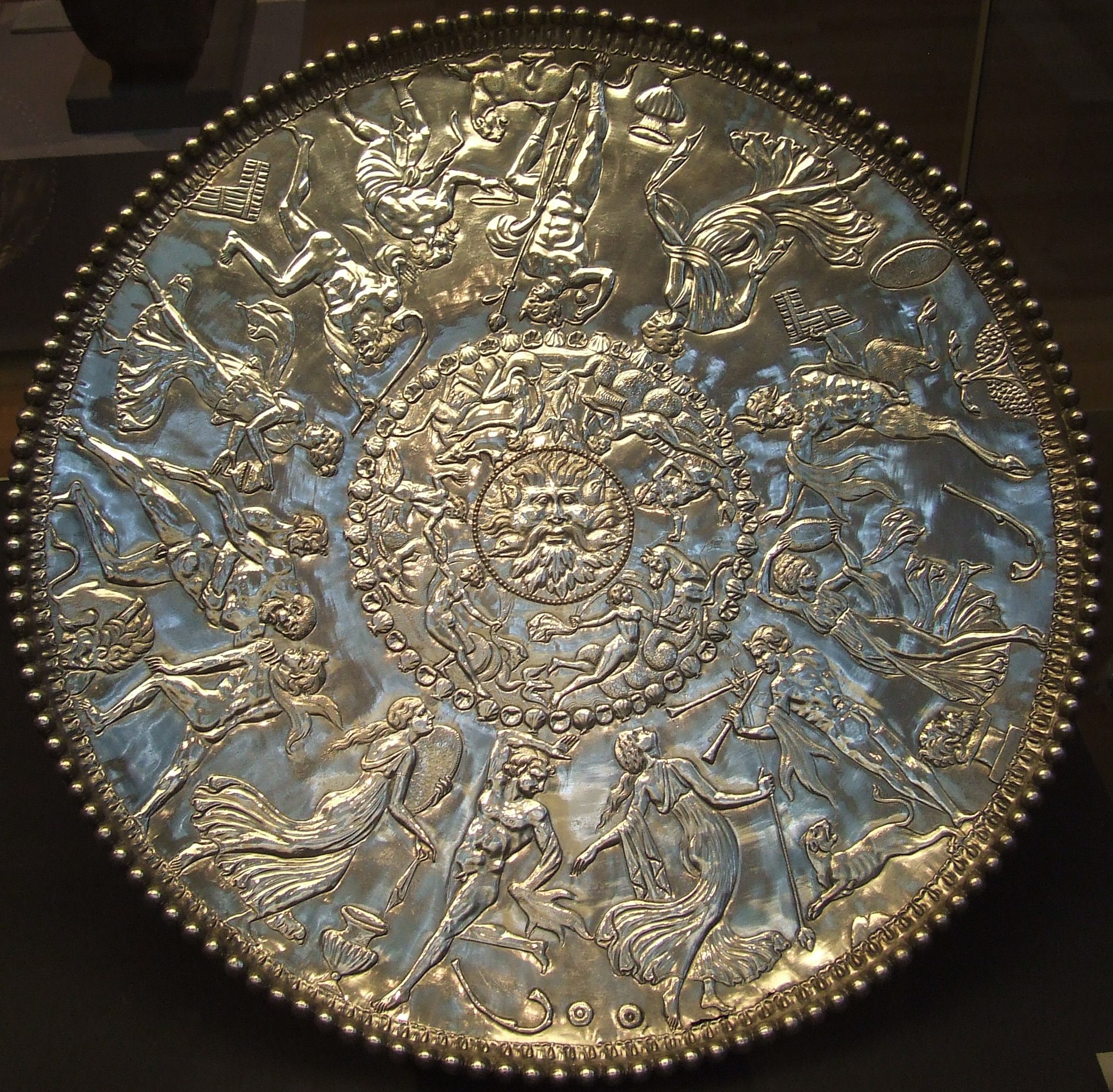
The Great Dish, or Great Plate of Bacchus
In 1946 he wrote a short piece for the Saturday Evening Post titled The Mildenhall Treasure. The story concerned the discovery in 1942 of a large hoard of Roman silver buried in the 4th century. The whole area of Suffolk is well-known for the large quantities of Bronze, Silver, and Iron Age archaeological objects recovered.
Dahl's story is a journalistic piece about the discovery. He spent time at both RAF Mildenhall and RAF Lakenheath. The bases my father worked when I was born.
Between Mildenhall and London lies Cambridge. James Clark Maxwell was there from 1850-56. He left for Aberdeen University to become their chair of Natural Philosophy.
In 1859, attempting to beat his former school to the punch, James Clark Maxwell demonstrated that the rings of Saturn could not be solid or they would break apart. He proposed the rings must be composed of small particles. Maxwell's theory was proven correct in 1895 through studies of the rings carried out by James Keeler.
crawling white (popularly so called) flower bag-shaped receptacle starting green moves to redness juicy acid pulp dotted over with tiny acorns crushed with sugar cream poured into bowls the smaller wood kinds creep at tree feet